
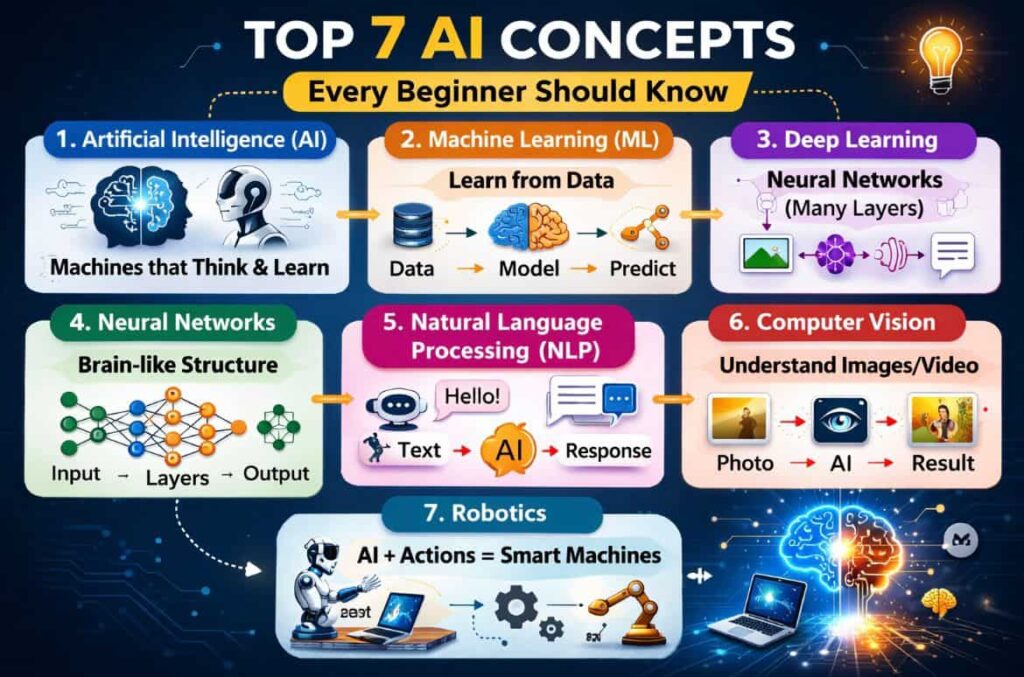
Top 7 AI Concepts for Every Beginner Should Know
AI for Beginner, artificial intelligence (AI) has become part of everyday life – from unlocking your phone using facial recognition to providing you with movie recommendations on Netflix; you are in contact with AI. If you are not familiar with AI, the complex language used around AI can make it difficult to understand. Many people hear words like “machine learning,” “neural networks,” and “NLP,” but do not know what they mean or how they relate to AI.
If you are brand new to AI, it is important to start with the basics. You do not have to be an expert in advanced mathematics immediately; however, you should be familiar with fundamental AI concepts. By learning and understanding these basic concepts, it will give you the confidence you need to continue exploring more detailed information about AI. In this article, we will review the most important concepts that are foundational for AI.
At the end of this article, you will be able to identify the different types of AI and understand how AI will affect your day-to-day activities, whether it be as a student, someone looking to change careers, or just a curious individual. Learning these foundational concepts of AI will be the first step towards becoming literate regarding future technologies. Let’s break down the complex fundamental concepts of AI into simple terms…
Why Understanding Core Concepts Matters
Before listing AI concepts, it is good to know why this theory has value. In a world where you can just use an application (app) to do things, should you really spend time learning about how those applications work?
Positive Argument: If you learn about AI for beginners and know the concepts that apply to every AI system, you can stop being a passive consumer of AI and instead, become an
active user. With this knowledge, you can judge the quality of AI tools based on their performance instead of simply trusting them.
Negative Argument: If you only rely on AI applications to perform tasks without understanding the underlying concepts, you will be vulnerable to being misled or confused about the value or capabilities of an AI-based application. Your knowledge of these concepts will protect you from being misled.
The Top 7 AI Concepts for Beginners:
Your compiled list of key concepts you should be aware of. Foundational elements listed first; more detailed elements will be listed after this section.
Machine Learning (The Engine)
Machine Learning (. A form of AI – the most common). Instead of a programmer manually writing explicit instructions for every possible task; we feed data into an ML algorithm and the algorithm learns the “patterns” from this data through experience.
- Good thing about using ML – the ability for ML to be able to analyze countless amounts of data provides solutions to some complex issues (e.g., predicting weather patterns, determining fraudulent transactions).
- The bad thing about using ML – Machine Learning models only provide meaningful results when the model has been trained with accurate and complete information. Therefore, the quality of data used to train ML models is an extremely important concept for an individual who is new to AI?
 Neural Networks (The Brain Inspiration)
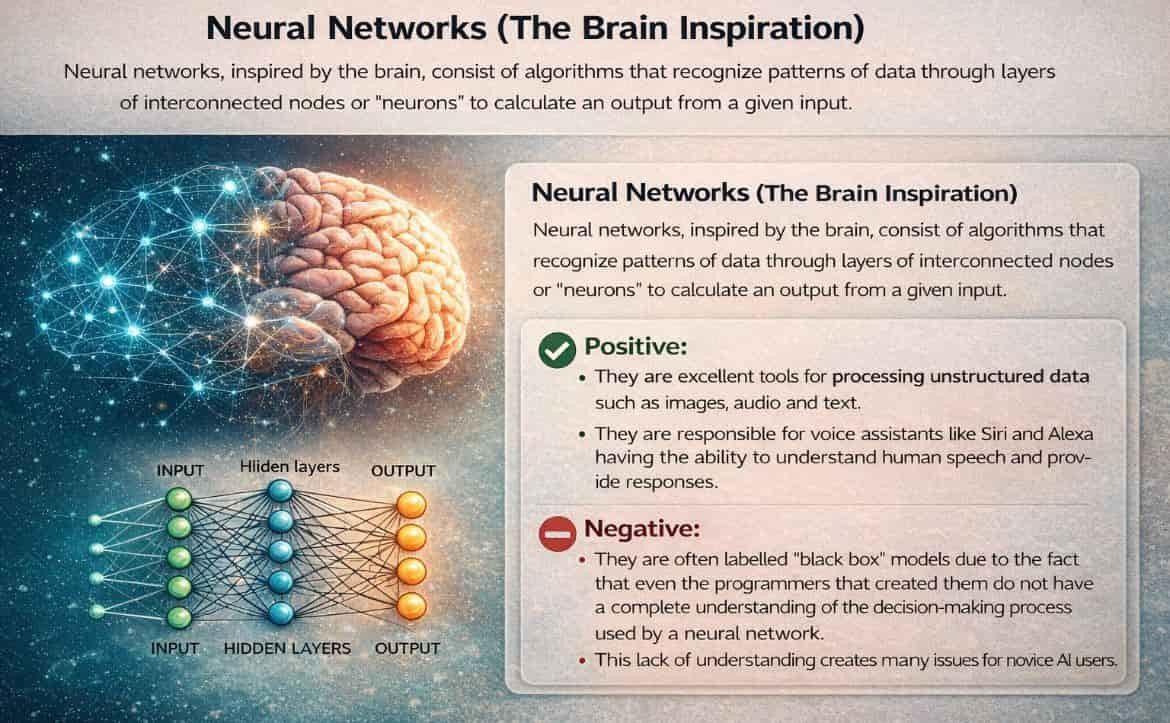 Neural Networks (The Brain Inspiration)
Neural networks, which are inspired by the brain, consist of many algorithms that work together to determine what is the relationship between some input and some output with the aim to recognize patterns of the data. Layers of nodes or “neurons” are used to convey information between multiple layers of nodes in order to calculate an output from the input provided.
- Positive: They are excellent tools for processing unstructured data such as images, audio and text. They are responsible for voice assistants like Siri and Alexa having the ability to understand human speech and provide responses.
- Negative: They are often labelled “black box” models due to the fact that even the programmers that created them do not have a complete understanding of the decision-making process that is used by a neural network. This lack of understanding creates many issues for novice AI users.
Natural Language Processing (NLP)
Natural Language Processing is the branch of Artificial Intelligence that enables computers to read, comprehend, and respond to human language. You are using Natural Language Processing when you ask ChatGPT a question or use Google Translate.
- Positive: It enables users to communicate effectively with machines, thus giving users the ability to use technology without being technically loaded.
- Negative: Human language can be complex and full of nuances such as humour, idioms, and ambiguity. Teaching a machine these complexities can be very difficult and therefore NLP systems can misinterpret the context in which they occur.
Computer Vision
Computer Vision (CV) is the use of Artificial Intelligence (AI) to have a computer interpret and understand visual data (photos, videos, and other forms of imagery). Once the computer understands this data, it can take actions based on it.
Benefits of CV: Life-saving technology, medical imaging analysis, self-driving automobiles. Costs: Privacy issues arise when combining many cameras with computer vision software; there are ethical concerns associated with surveillance.
Generative AI (GAI)
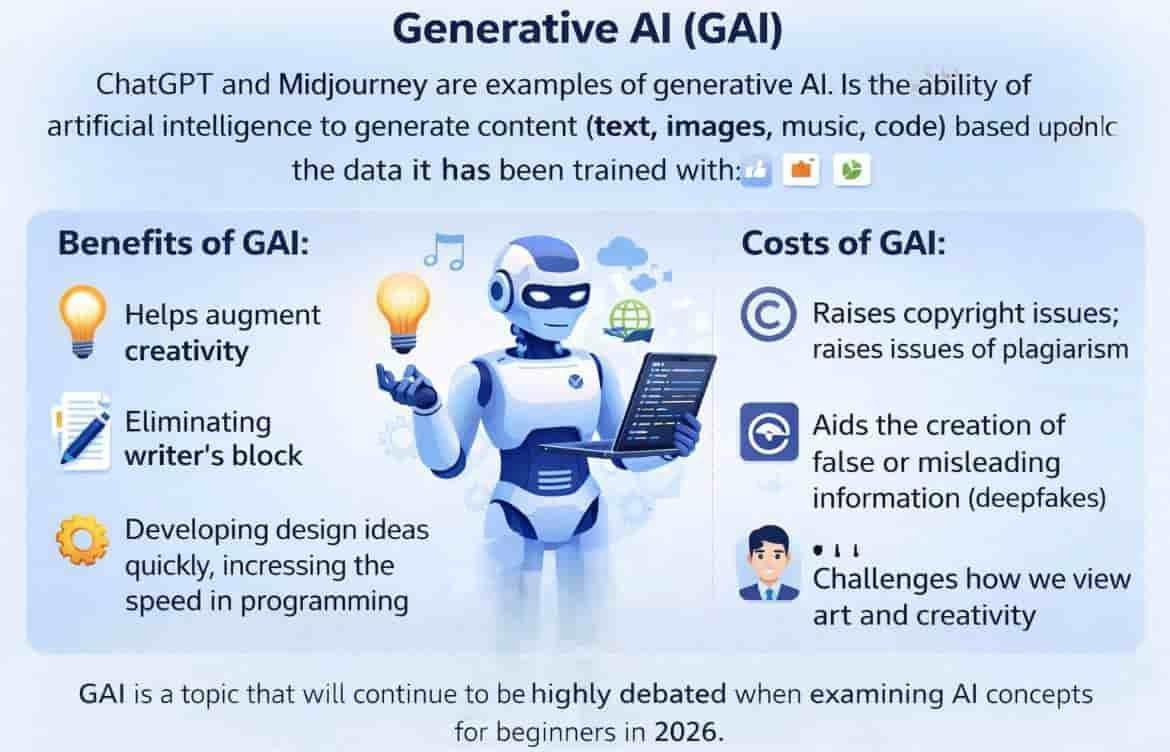 ChatGPT and Midjourney are examples of generative AI. GAI is the ability of artificial intelligence to generate content (text, images, music, code) based upon the data it has been trained with.
Benefits of GAI: Helps augment creativity, eliminating writer’s block, developing design ideas quickly, increasing the speed in programming.
Costs of GAI: Raises copyright issues; raises issues of plagiarism; aids the creation of false or misleading information (deepfakes); challenges how we view art and creativity. GAI is a topic that will continue to be highly debated when examining AI concepts for beginners in 2026.
Reinforcement Learning
Think about training a dog. You reward your dog whenever it does the right thing, and that’s how Reinforcement Learning works. The AI agent learns how to make decisions by taking actions and getting rewarded or punished.
- Positive: This is a great method for training AI to play games (like AlphaGo) and for robots to learn how to do things by trial and error without ever being told how to do those things specifically.
- Negative: Training the AI can take a lot of time and processing power to complete the task. If the “reward” system has been poorly designed, the AI will find a way to cheat the system in some way that is unexpected and often harmful.
Ethical Considerations and Biases in AI
Ethics and ethical issues are one of the most important conceptual areas. Ethical AI will play an increasing role in how decisions are made about our lives, including loans, job opportunities, and diagnoses from our physician. It is essential that when AI makes these kinds of decisions, they are fair and that AI does not introduce an element of bias or the like when making decisions because AI can often learn from the data it has been trained on.
- Positive: There is growing interest in the ethical use of AI, leading to the creation of more robust, reliable, and fairly distributed AI goods that will benefit all of humankind.
- Negative: If these ethical issues are not given priority. AI has the potential to continue to extend the existing imbalance in how society operates with regard to things such as employment. For instance, if a hiring algorithm is based on historical figures of applicants, it is possible that the algorithm will learn to discriminate against various demographics during the hiring process. Therefore, ethics needs to be the foundation for today’s artificial intelligence.
How to Learn These Concepts Effectively
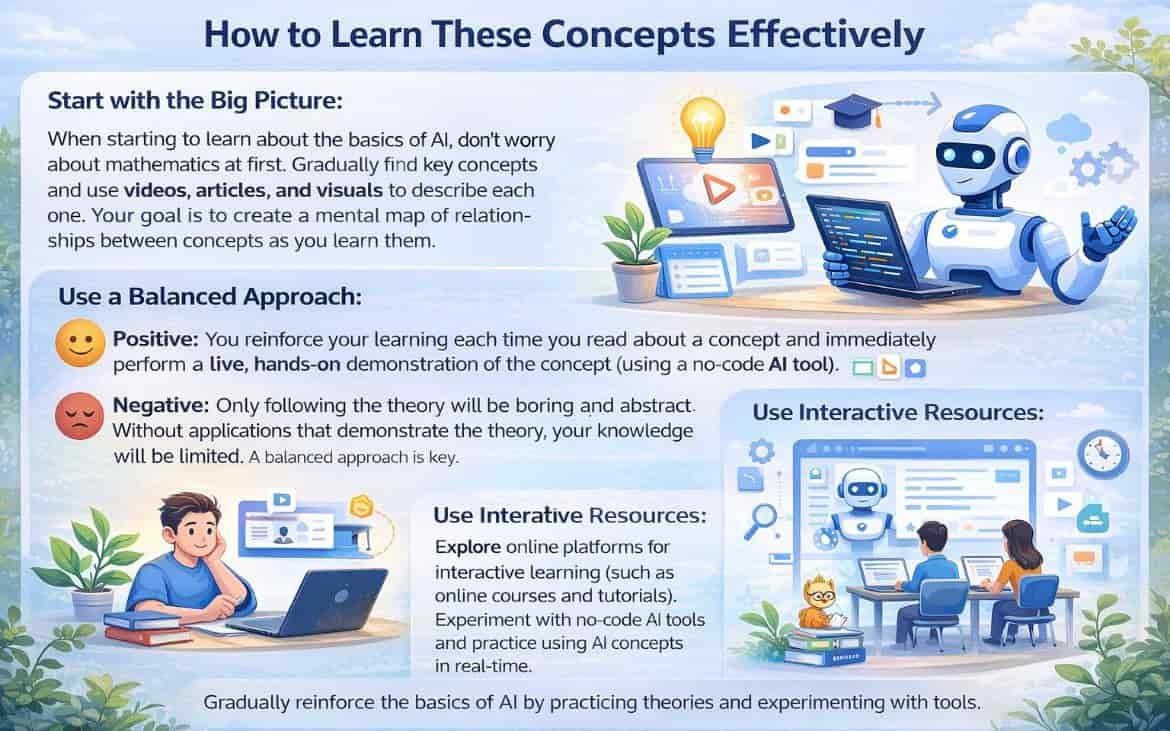 How to Learn These Concepts Effectively
Start with the Big Picture:
When starting to learn about the basics of AI, don’t worry about mathematics at first. Try to find some key concepts and view them gradually using videos or articles that use visuals to help describe each concept. The goal is to create a mental map of the relationships between each concept as you create it.
Use a Balanced Approach:
- Positive: You reinforce your learning every time you read about a concept and immediately perform a live, hands-on demonstration of the concept (using a no-code AI tool).
- Negative: Only following the theory will be boring and abstract. However, if you only use applications without understanding the theory, your knowledge will be limited. Therefore, a balanced approach is very important.
Use Interactive Resources:
There are many online platforms (e.g., ailacenter.tech) that can serve as your main learning hub. Look for interactive training programs (such as online courses and/or tutorials) where you will have opportunities to explore and experiment with new tools and techniques to reinforce your understanding of the basic concepts of AI by actually seeing them work.
Frequently Asked Questions (FAQ)
Do I need to know math to understand these concepts?
Is it necessary to have any knowledge of mathematics for the understanding of AI? In terms of a conceptual basis, no, you do not have to have any calculus or other types of mathematics to understand how these concepts work within the context of AI. However, if you are going to develop your own AI or build upon existing systems, then you will have to learn both linear algebra and statistics over time as well.
What is the most important of these seven concepts? The foundation for almost all of the other six concepts is Machine Learning. If you understand Machine Learning, then it will make it much simpler to place the other beginner AI concepts into context. Therefore, this is an excellent starting point for your journey into this field.
Approximately how long does it take to learn all seven? It will take a few weeks of informal study to get a fundamental understanding of all seven, but to develop a working knowledge of each will require several months of practice and developing projects. As such, this should be approached from a long-range perspective and should not be viewed as an event completed in a short amount of time.
Conclusion:
 Conclusion:
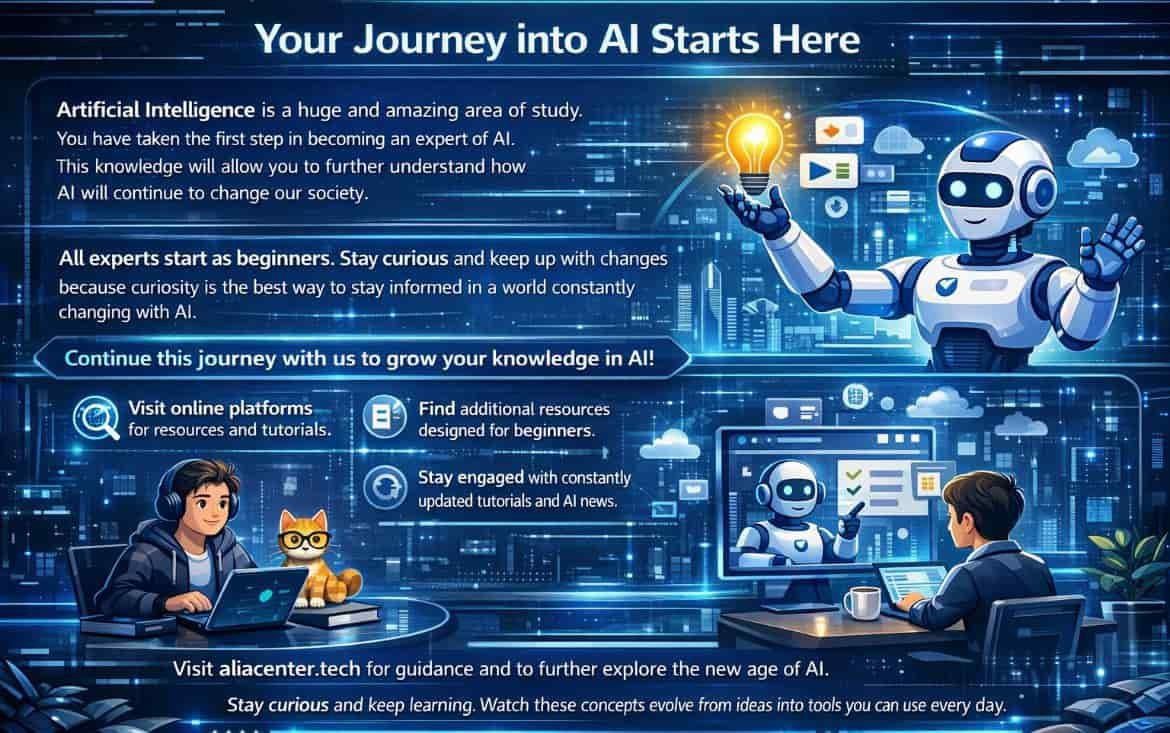
Your Journey into AI Starts Here
Artificial Intelligence is a huge and amazing area of study; however, you do not need to be overwhelmed by it. You have already made your first step (and a really big one) towards being an expert in AI by being educated in these seven concepts as a foundation of knowledge about AI. These AI concepts for beginners will enable you to further comprehend how AI will continue to change our society.
All experts were once beginners. So remain curious and keep up with all of the changes happening in the field because curiosity is the best form of staying informed in a constantly changing world. So please continue this journey with us by visiting ailacenter.tech often for additional resources, guidance, and tutorials designed specifically for you to be able to successfully navigate your way through this new age of AI (the AI revolution). Stay curious and continue to learn, and you will see these concepts evolve from ideas into tools for you to use every day.
