Python Basics: Core Programming Concepts Every Beginner Must Learn (2026)
Getting Started with Python Basics
Following a clear understanding from the previous guide we can now begin to dive into Python Basics in much greater detail. It is now time for some actual programming. If you genuinely want to get comfortable with writing code then this is where it becomes crucial that you learn some basic programming concepts using Python.
In this guide we will cover each element from Python variables right up to the Python keywords in detail but in a clear, understandable and professional way. If you are a student or self-taught, then this blog post will reinforce and build up your foundational understanding.
Why Learning Python Basics Is Important
Before I could go further in exploring complex programming languages, it’s important that I first grasp on the very fundamentals of the Python programming language. Such fundamentals are used to explain to the programmer on how a program handles its data, and makes decisions.
Without this foundation on the core programming concepts in Python basics, there is absolutely no point for me to venture into more complicated and more complex languages; such as functions, loops, and/or the object-oriented approach of programming. Understanding how Python handles data is key for advanced fields. See how these basics apply in AI in Healthcare 2026: How Machines Help Doctors Save Lives
Now let us explore on the various concepts one by one.
Variables in Python
One of the initial and crucial things we need to discuss in Python Basics is Python variables.
Variables store information. You can imagine it like a container holding a piece of data to use in your program later.
Example:

In this example:
- name stores text
- age stores a number
There is no need to declare a type to a variable in Python prior to its use. This is not like in many other programming languages.
First, to fully grasp the basics of Python for a beginner you have to learn how to use variables.
Data Types in Python
During learning Python basics, you have to know data types of python. Data type means the type of value a variable represents.
Some common data types include:
- int (Integer) → 10, 25, -5
- float → 3.14, 2.5
- str (String) → “Hello”
- bool (Boolean) → True or False
Example:
Python recognizes and identifies the data type on the basis of the value assigned. This capability of Python language is quite easy for understanding programming concepts in Python.
 Data types are important because they impact the ways that operations perform in your program.
Type Casting in Python
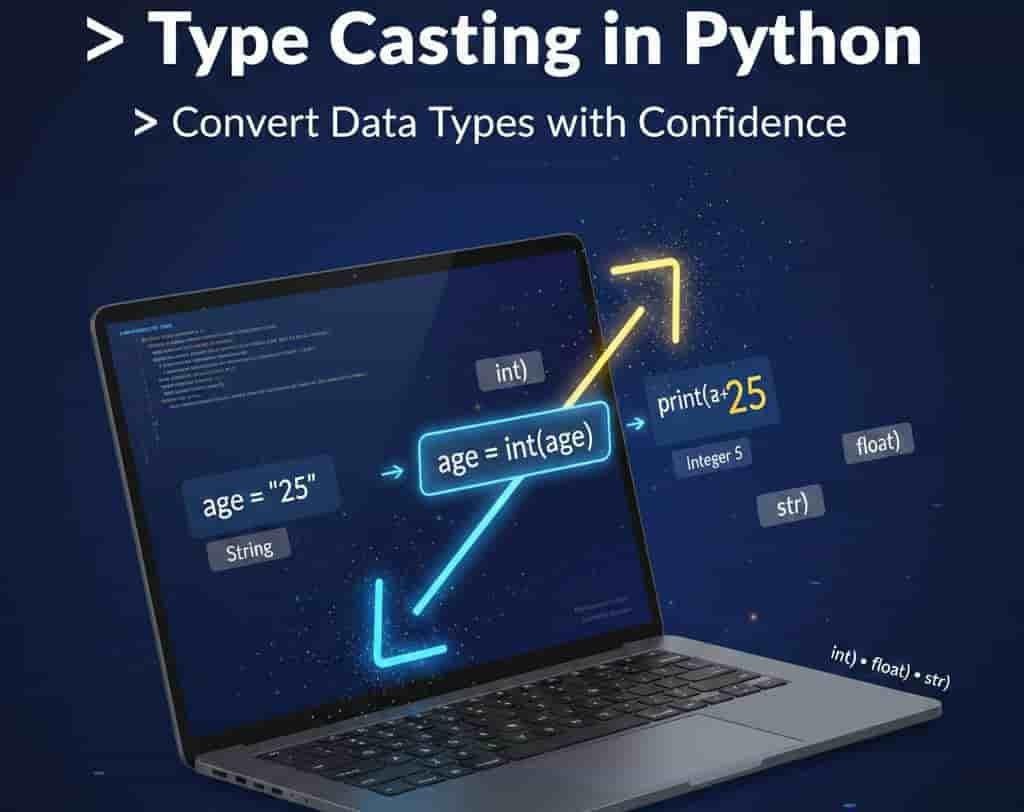
There may be times in Python programming where you have to convert one type of data to another type. This action of type conversion is called Type Casting in Python. Type casting is of much importance when you work with different kinds of data, such as user input, computations etc.
Let’s say you take input from a user with the help of the input() function then Python takes the value input by the user as a string by default. Let’s say, the user input value as an integer, then you have to convert that input string to an integer data type in order to perform addition, subtraction, multiplication and so on.
Example:

Here in the example string “25” has been converted into an integer data type using int(). Here once it converted into an integer can be operated like any other numerical value.
Common Type Casting Functions in Python
Python provides several built-in functions for explicit type conversion:
- int() – Converts a value to an integer
- float() – Converts a value to a floating-point number
- str() – Converts a value to a string
Understanding the concept of Python type casting in the right way would make your knowledge of the basics of Python much strong. This would not only reduce errors but would make your programs more robust and correct.
Taking User Input in Python
An interactive program must accept input from users. In Python Basics, this is done using the
input() function.
Example:

Here, the program asks the user for their name and then prints a greeting. Remember:
- input() always returns a string.
- If you need a number, use type casting.
Example:

Mastering user input in Python allows you to build dynamic and interactive programs.
Python Operators – Python Basic Concepts
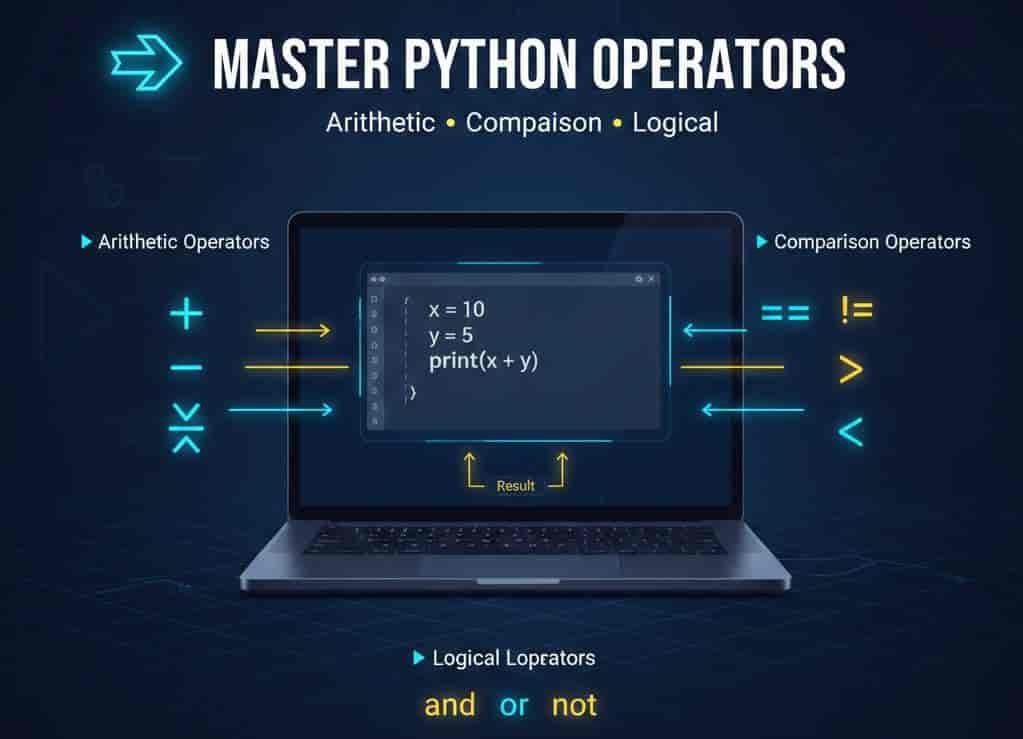
In Python’s journey towards understanding the basics of Python, knowing Python operators is very crucial. Operators are special characters in the programs which perform actions on variables and values. This means with help of operators we can do some calculations, comparisons and logical decisions. Without operators, we can never write effective programs in Python.
In learning Python operators helps in improving the understanding of Python basic programming. These are needed in nearly every kind of application-from simple calculators to software applications.
Arithmetic Operators in Python
Operators which are used most often in basic programming in python are arithmetic operators. Arithmetic operators are used to make mathematical computations.
Common Arithmetic Operators:
● + Addition – Adds two values
- – Subtraction – Subtracts one value from another
- * Multiplication – Multiplies two values
- / Division – Divides one value by another
Example:
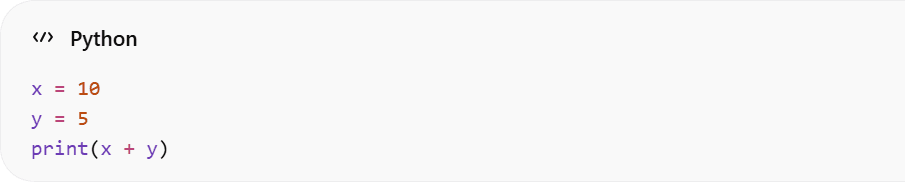
In the example above, the + operator adds together the two values, x and y. The result printed to the console will be 15.
Arithmetic operators are very fundamental to learning the basics of Python since they are involved in virtually every kind of computation, formula, and calculation needed. Understanding the operators listed here will boost a beginners confidence to get on the path to mastering more complex python concepts.
If you’re interested, I’m more than happy to write about comparison, logical, and assignment operators in the same SEO-friendly tone as the section above.
Common Comparison Operators:
In Python basics, two values are compared using comparison operators. The program uses these operators to aid make decisions by returning True or False. Because they are frequently used in loops and if statements, comparison operators are an essential component of understanding Python basics for beginners.
Common Comparison Operators:
● == Equal to – Checks if two values are equal
- != Not equal to – Checks if two values are different
- > Greater than – Checks if one value is larger than another
- < Less than – Checks if one value is smaller than another
By mastering comparison operators, learners build a strong foundation in Python basics, especially when working with decision-making logic.
Logical Operators – Python Basics
Logical operators are used in Python basics to combine several conditions into one statement. When creating intricate decision-making programs, these operators come in particularly handy.
Common Logical Operators:
Logical operators are used in Python basics to combine several conditions into one statement. When creating intricate decision-making programs, these operators come in particularly handy.
- and – Returns True if both conditions are true
- or – Returns True if at least one condition is true
- not – Reverses the result (True becomes False, and vice versa)
Gaining an understanding of comparison and logical operators in Python basics helps you better understand basic programming ideas. With their assistance, you can design more intelligent and dynamic applications and manage the program’s flow.
Comments in Python
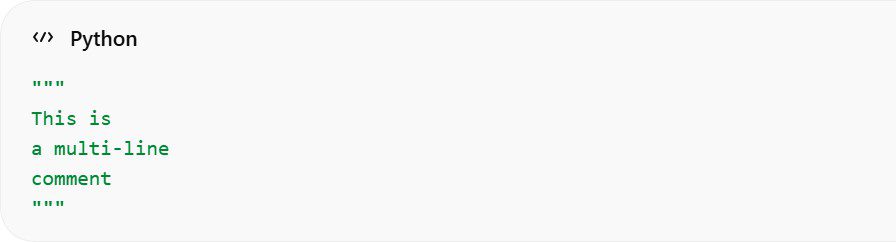
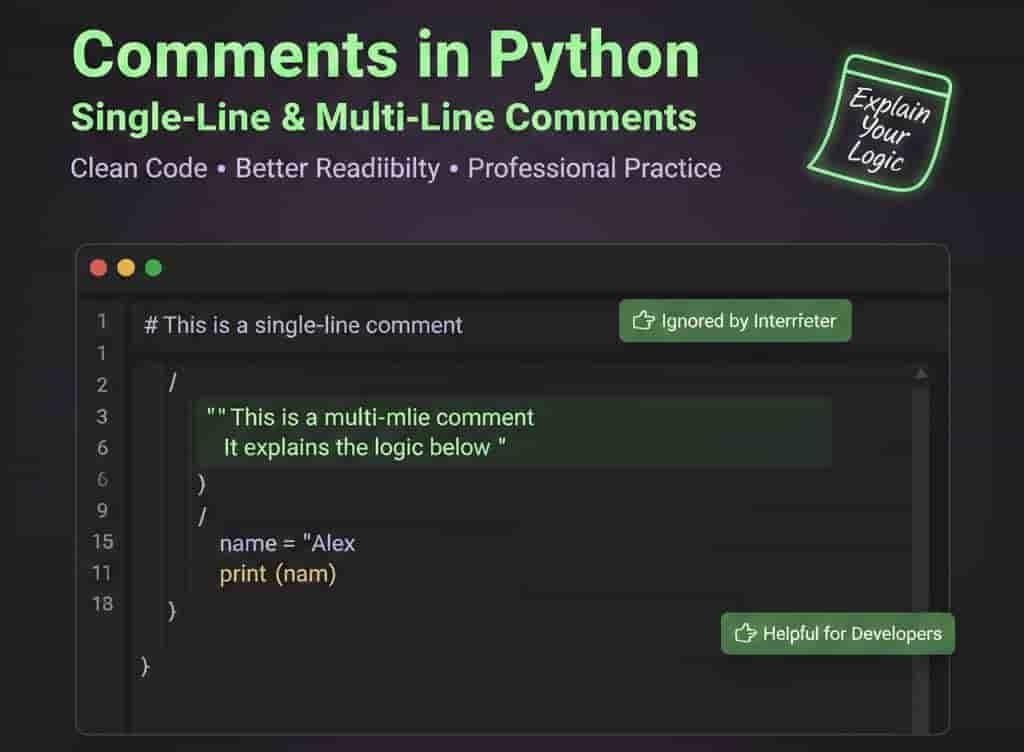
While writing programs, adding explanations inside the code is important. These explanations are called comments in Python.
Comments are ignored by the interpreter but help humans understand the code.
Single-Line Comment

Multi-Line Comment
Keywords in Python
Knowing Python keywords is a vital component of Python Basics.
In Python, reserved words with particular meanings are called keywords. They aren’t suitable for variable names.
Some common Python keywords include:
- if
- else
- for
- while
- True
- False
- def
- return
Gaining an understanding of Python keywords helps you get ready for the next phase, which involves control flow and functions.
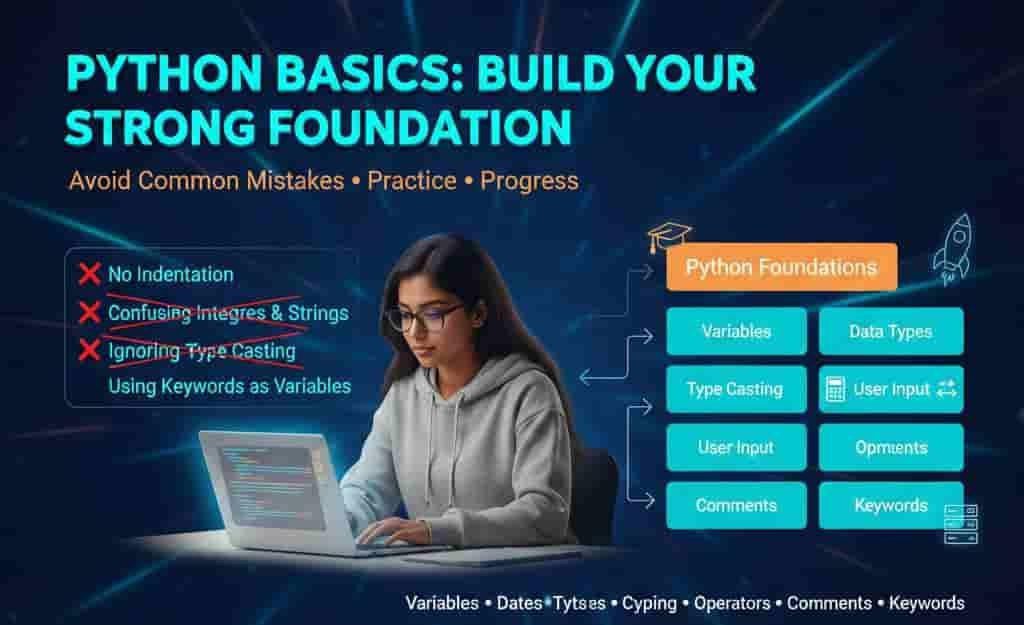
Common Mistakes Beginners Make
When learning Python basics for beginners, many students:
- Do not use indentation.
- Use integers to confuse strings.
- Use of type casting with input is overlooked.
- Utilise keywords while naming variables.
- Steer clear of these errors to accelerate your learning.
How Python Basics Build Your Programming Foundation
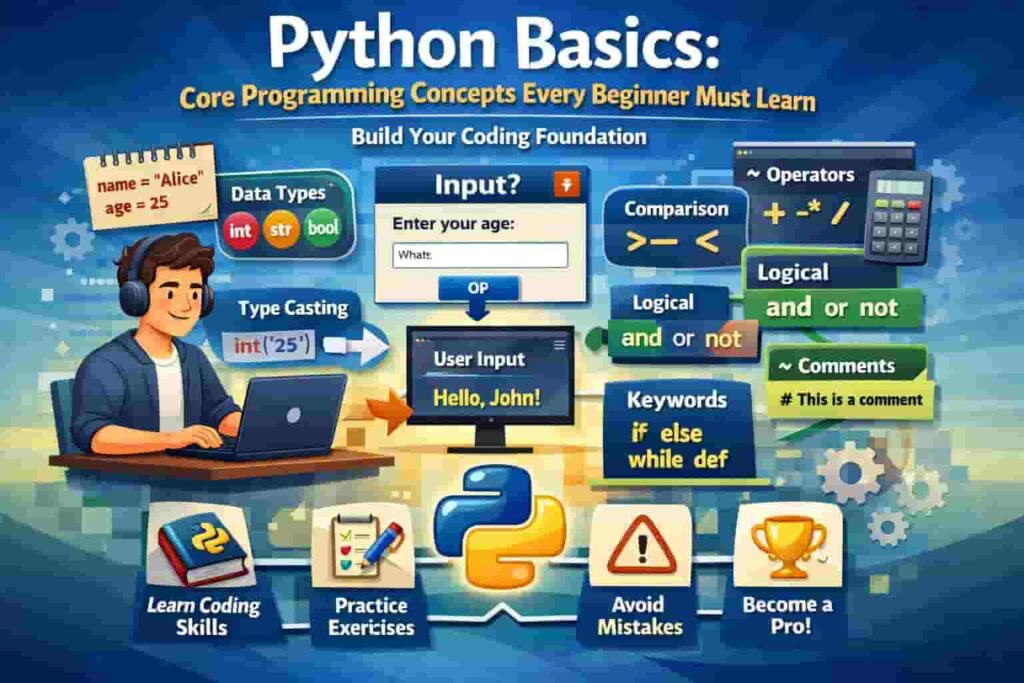
Variables in Python, data types in Python, type casting in Python, user input in Python, operators in Python, comments in Python, and Python keywords are all significant concepts that are covered in this guide.
They are the basic units of programming.
If you grasp these Python programming ideas, you can proceed with assurance to:
- Conditional statements
- Loops
- Functions
- Data structures
- Object-oriented programming
Conclusion: Master Python Basics Before Moving Forward
It takes more than just building simple programs to learn Python basics. It’s about knowing how software functions and thinks.
These basics Python programming ideas lay the groundwork for everything you will construct in the future. This is the first step towards becoming a web developer, data scientist, AI engineer, or automation specialist.
Take time to practice each topic:
- Practice variables
- Experiment with data types
- Try type casting
- Build small input-based programs
- Use operators in calculations
Once your foundation is strong, advanced Python will feel much easier.