
NumPy Lesson 02: Advanced Slicing and Data Filtering
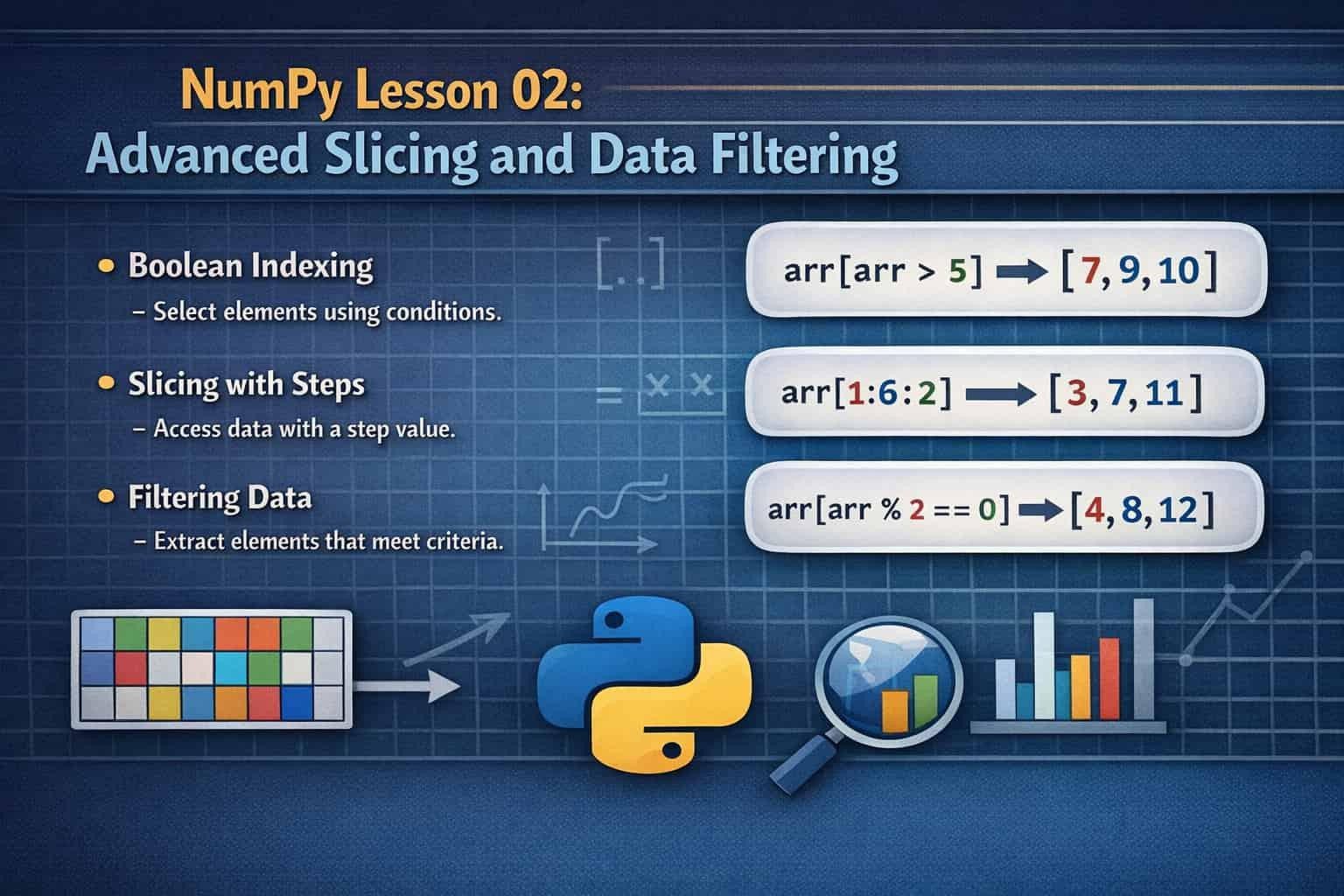
NumPy Slicing is a fundamental technique used to extract a portion of an array by specifying index ranges. Instead of accessing individual elements one by one, slicing allows developers to retrieve multiple elements at once, making it essential for tasks like data preprocessing and machine learning dataset preparation. Understanding how to efficiently slice and filter data is critical for any AI researcher working with large volumes of information.
Data scientists, machine learning and AI researchers must use large amounts of information as part of their day-to-day jobs, so it’s critical to do this efficiently. The Python language has many libraries for working with numbers on computers, including the popular numerical computation library, NumPy. NumPy is an essential tool for quickly performing mathematical computations on large amounts of numeric data in array and matrix structures.
🚀 Interactive Learning: To follow along with the code and run these examples live, check out our official Kaggle Notebook: NumPy Lesson 2.
One of the more important capabilities included with NumPy is the ability to slice (extract) data from arrays without writing numerous lines of code or looping through an array’s elements. This capability provides faster, more readable and cleaner code for processing data arrays than traditional methods of accessing array elements.
This lesson will examine advanced slicing and filtering when working with NumPy libraries. You will learn how to slice and select rows and columns from arrays, how to filter arrays of data based on conditions, and how to work with multi-dimensional arrays using these capabilities.
Understanding NumPy slicing is essential for tasks such as:
- Data preprocessing
- Feature selection
- Data filtering
- Machine learning dataset preparation
- Scientific computing
NumPy arrays are optimized for numerical computation and allow efficient manipulation of large datasets compared to traditional Python lists. They provide powerful indexing and slicing capabilities that help users access specific elements or groups of elements quickly.
Understanding NumPy Arrays
Before learning NumPy Slicing, it is important to understand what NumPy arrays are.
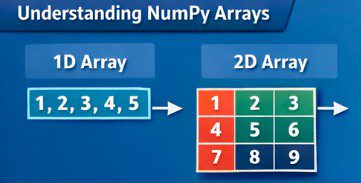 A NumPy array is a collection of elements arranged in a grid-like structure. These arrays can be:
- 1D arrays (vectors)
- 2D arrays (matrices)
- 3D or higher-dimensional
NumPy arrays are faster and more memory efficient than Python lists because they store elements of the same data type.
Example: Creating a NumPy Array
import numpy as np
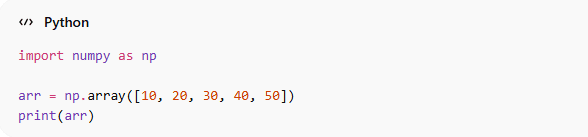
Output:

Here, we created a simple NumPy array containing five numbers. NumPy also allows creating arrays using built-in functions like:
- np.zeros()
- np.ones()
- np.arange()
- np.random.rand()
Example:

Output:

What is NumPy Slicing?
NumPy Slicing is a technique used to extract a portion of an array by specifying index ranges. Instead of accessing individual elements one by one, slicing allows us to retrieve multiple elements at once.
The general syntax for slicing is:
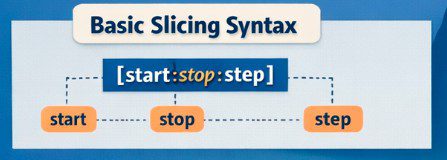

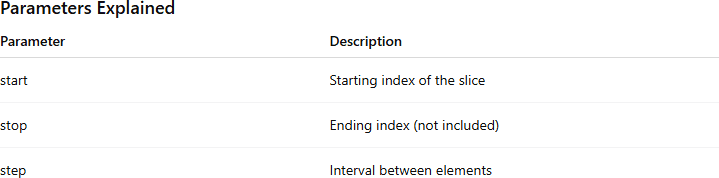
Example:

Output:

This means we selected elements starting from index 1 up to 3.
Basic NumPy Slicing Examples
Selecting First Elements

Output:

Selecting Elements from Middle

Output:

Using Step in Slicing

Output:

The step value selects every second element.
Negative Indexing in NumPy

NumPy also supports negative indexing. This allows you to access elements from the end of the array.
Example:

Output:

Negative indexing is very useful when working with large arrays where the exact position of elements might not be known.
NumPy Slicing in 2D Arrays
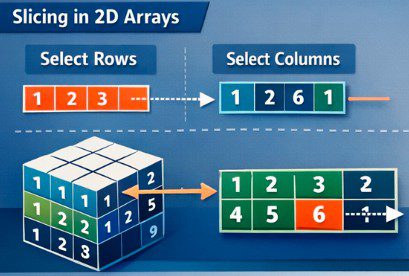
Most real-world datasets are stored as two-dimensional arrays, where rows represent records and columns represent features.
Example:

This is a 3 × 3 matrix.
Selecting Rows

Output:

Selecting Columns

Output:

Here, the : symbol means select all rows.
Selecting Multiple Rows and Columns
NumPy slicing allows selecting both rows and columns simultaneously. Example:

Output:

Explanation:
- 0:2 selects the first two rows
- 1:3 selects the second and third columns
Advanced NumPy Slicing Techniques
Advanced slicing techniques allow users to work efficiently with multi-dimensional data.
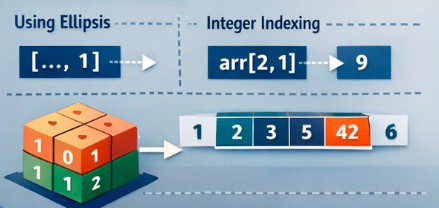
Using Ellipsis (…)
The ellipsis operator (…) allows selecting entire dimensions without writing all indices. Example:

This extracts the second element from each sub-array.
This feature becomes very useful when working with 3D or 4D arrays used in machine learning or image processing.
Using Slice Objects
 Python also allows creating slice objects. Example:
This produces the same result as:

Slice objects make code more reusable and readable when working with multiple slicing operations.
Integer Indexing in NumPy
 Integer indexing allows selecting specific elements using arrays of indices. Example:
Output:

Here:
- (0,0)
- (1,0)
- (2,1)
positions are selected from the array.
This technique is useful when you want to extract elements from different positions.
Boolean Indexing for Data Filtering
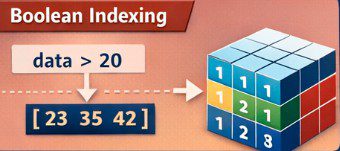
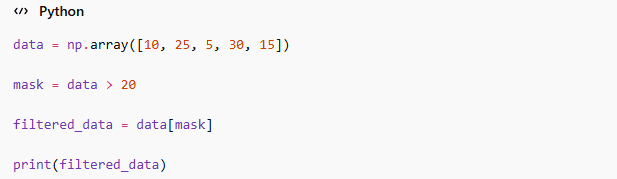
One of the most powerful features in NumPy is Boolean indexing. It allows filtering data based on conditions.
Example:
Output:

Explanation:
- First we create a condition data > 20
- NumPy generates a Boolean mask
- The mask selects elements that satisfy the condition
Boolean indexing is widely used for data filtering in machine learning datasets.
Filtering Rows in Multi-Dimensional Arrays
Example:

Output:

Here we filtered rows based on the sum of values.
Real-World Applications of NumPy Slicing
Data Cleaning

NumPy slicing helps remove unwanted columns or rows from datasets before training machine learning models.
Example:

This selects the first three columns as features.
Feature Selection

In machine learning, slicing helps select important features from a dataset.
Example:

This selects the target variable.
Image Processing

Images are stored as multi-dimensional arrays. NumPy slicing allows:
- Cropping images
- Extracting color channels
- Processing image segments
Data Transformation
 NumPy slicing helps modify large datasets quickly without using loops. For example:
This replaces the first three elements with zero.
Common Mistakes When Using NumPy Slicing
Confusing Indexing and Slicing
- Indexing returns a single element
- Slicing returns a subset of elements
Example:

Forgetting that Stop Index is Exclusive
 Many beginners think the stop index is included, but it is not. Example:
Returns elements from index 1 to 3 only.
Shape Mismatch Errors
 When slicing multi-dimensional arrays, incorrect indices can produce unexpected shapes. Always check the shape using:
Best Practices for NumPy Slicing
Here are some tips to master NumPy Slicing quickly:
- Practice slicing with small arrays first
- Visualize rows and columns before slicing
- Use Boolean indexing for filtering data
- Use slice objects for reusable slicing operations
- Always check array shape before slicing
Frequently Asked Questions (FAQs)
What is NumPy slicing?
NumPy slicing is a method used to extract a portion of an array using index ranges.
What is the syntax of NumPy slicing?

Boolean indexing filters array elements using conditions such as >, <, or ==.
Does slicing copy the array?
Most NumPy slicing operations return a view, not a copy of the original array.
Can NumPy slicing be used with multi-dimensional arrays?
Yes. NumPy slicing works with 1D, 2D, and higher-dimensional arrays.
Why is NumPy slicing important in machine learning?
It helps in selecting features, filtering datasets, and preparing training data efficiently.
Conclusion
In this lesson, we explored NumPy Lesson 02: Advanced Slicing and Data Filtering and learned how powerful NumPy Slicing can be when working with numerical data.
We covered:
- Basic slicing syntax
- Slicing in 1D and 2D arrays
- Advanced slicing techniques
- Boolean indexing for filtering
- Real-world data science applications
NumPy slicing is one of the most important skills for anyone learning data science, machine learning, or AI. By mastering these techniques, you can manipulate datasets efficiently and write cleaner, faster code.
Practice these examples regularly, experiment with different slicing operations, and soon you will become comfortable handling even very large datasets with ease.
Professional Resources & Support
YouTube Channel: Subscribe to AI Learner Tech for video tutorials on NumPy, Data Science, and AI
 .
.Source Code: Access the full code for this tutorial and future projects on our GitHub Organization
.Daily AI Updates: Follow us on LinkedIn for short clips, industry trends, and quick tips
.Join the Discussion: Become part of our Facebook AI Community to interact with experts
.Support & Inquiries: For questions or collaborations, reach out to us at contact@ailearner.tech
.
 .
. .
. .
. .
. .
.
Author: AI Learner Tech
AI Learner Tech is a premier research and educational hub dedicated to mastering Artificial Intelligence, Machine Learning, and Computer Vision. We bridge the gap between complex academic theories and real-world industrial applications. Join our community to access high-quality tutorials, open-source projects, and expert insights. Website: ailearner.tech
