

How to Understand Artificial Intelligence Quickly
AI isn’t a technology of the future. It’s an engine of the present. AI is changing every aspect of how we live and work; from how we purchase goods to how we diagnose medical conditions, AI is changing how we view and do everything in our world. AI feels like a big word for many people and thus may seem intimidating. To many professionals and students, the need for understanding AI is no longer an optional skill; it’s a career requirement. The pace of technological change is so fast it’s easy to feel like you’re falling behind.
A practical guide to Mastering AI Fundamentals
The good news is that you don’t need a Ph.D. in advanced mathematics to grasp basic AI concepts. It may take years to develop the ability to master the technical details of AI; however, from a functional and practical perspective, developing your basic understanding of AI should be relatively easy. This guide has been created to help you get the information you need to understand AI by breaking down the subject into manageable concepts, with practical steps you can take to gain a functional understanding of AI.
If you want your company to remain successful and competitive in today’s rapidly evolving digital economy, mastering the basics and understanding how to fully leverage new technologies is essential. This article outlines what makes up an AI system, the different stages of making an AI product, and how to navigate the different debates surrounding AI technology. At the end, you will be prepared to use AI effectively, as well as gain a deeper understanding of AI’s overall impact.
The Foundational Layers: What You Need to Know
Building a foundation of knowledge is crucial prior to exploring any sort of complex algorithmic function. In order to gain a full understanding of AI, you must first differentiate it from the subsets thereof; ie. supposing you wanted to understand AI, would classify AI as the broad category of machines emulating “human-like” intelligence, but ML as being a
subset of AI, where machines learn through exposure to data. Finally, DL consists of applying neural networks (i.e., the structure and function of the human brain) to problems within the realm of ML.
To help you quickly understand AI at a very high level, you should familiarize yourself with some keywords/terminology associated with AI and its corresponding functions (using various algorithmic functions):
- 1st Place – Algorithms: The step-by-step procedures used to execute an instruction performed by a computer or computing system (to accomplish “solving a problem”).
- 2nd Place – Models: The product produced by running (training) an algorithm on different sets of data.
- 3rd Place – Natural Language Processing (NLP): Enabling a computing system to “understand” and interpret “natural language” as produced via human communications.
- 4th Place – Computer Vision: Enabling a computing system to interpret and make decisions based upon visual representations of data collected about the real world.
 The Role of Data and Programming
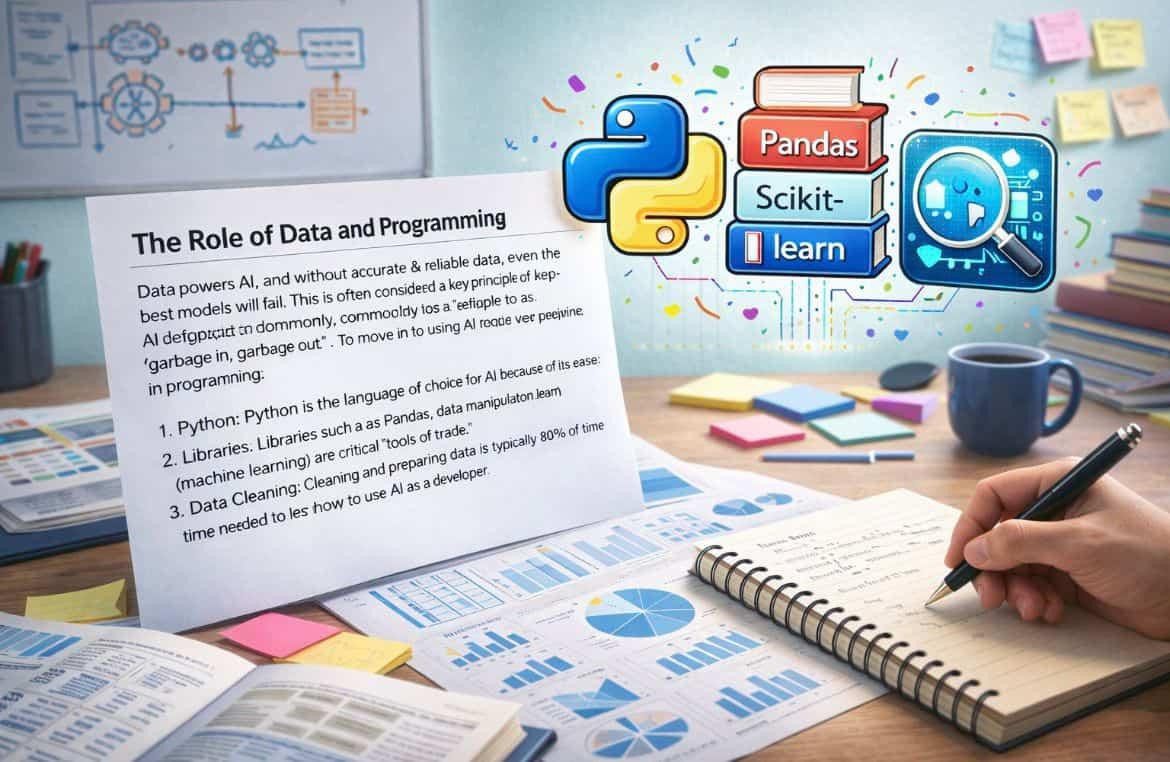 The Role of Data and Programming
Data powers AI, and without accurate & reliable data, even the best models will fail. This is often considered a key principle of AI development, commonly referred to as “garbage in, garbage out”. To move from using AI to developing AI requires proficiency in programming:
- Python: Python is the language of choice for AI because of its ease of use.
- Libraries: Libraries such as Pandas (data manipulation) and Scikit-learn (machine learning) are critical “tools of the trade.”
- Data Cleaning: Cleaning and preparing data is typically 80% of the total time needed to learn how to use AI as a developer.
A Structured Learning Plan
If you want to be able to learn about AI quickly, you need to have a defined learning path vs just experimenting. You need to start with a clearly defined goal such as: Do I want to apply AI in my current position? Or am I interested in developing AI? Once you establish a learning path tailored to your objectives and an outline of your expected progress, you will then be able to concentrate on using your time effectively and measuring how you’re doing towards achieving your goal.
Start with the Accessible Tools
You can develop practical knowledge of Artificial Intelligence even if you don’t have coding experience.· Experimenting with AI: Engaging with existing AI services such as ChatGPT, Microsoft Copilot, or DALL-E will allow you to experiment with AI and see how they can complete tasks and create useful work products for you.
· Prompt Engineering: Experimenting with AI will help you learn about prompt engineering naturally and intuitively by providing insight into how to write an effective user prompt for an AI model.· Learning the AI Toolbox: You will learn about the tools available in AI and their limitations when using these methods, regardless of whether or not you have a technical background.
Begin with a Structured Learning Approach
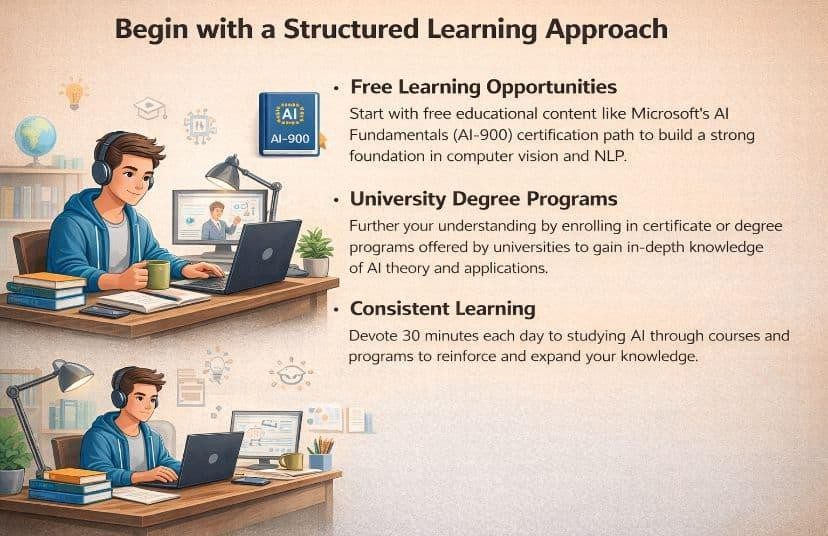
After becoming familiar with using AI tools, now is the time to explore more structured educational opportunities.· Free Learning Opportunities: Start with free educational content through paths such as Microsoft’s AI fundamentals (AI-900) certification path. This will give
you a strong foundation in topics such as computer vision and natural language processing (NLP).
· University Degree Programs: For furthering your understanding of AI beyond the simple tools available, many universities offer certificate programs that will prepare you with a thorough understanding of the theory underlying many areas of AI, which will enable you to apply AI successfully in any field. Consistent Learning: By devoting 30 minutes each day to your learning through the above-mentioned resources, you will be well-equipped to understand AI in its entirety.
Build and Specialize
Theoretical grounding only comes with practical experience where you can learn to use artificial intelligence through practice.
Sandbox Environments: Develop small-scale projects like a note-summarizer or simple chatbot via a cloud-based platform.
Portfolio Development: Get your projects down on paper, that way when you apply for jobs, you can show your experience.Gaining Confidence can lead to Specialization in a field of your interest (robotics, data science, generative AI).
Debate: Pro/Con Argument for AI
Using AI offers transformative advantages that would be difficult to debate against. Understanding the benefits AI will provide, will help create an understanding of Artificial Intelligence being the means or tool for creating progress. Some of these benefits are the increase in efficiency/productivity, by virtue of changing the way we do our work.
AI is a Revolution in Business:
· Automating: AI takes over repetitive tasks so that employees are freed up to spend their time on more strategic/creative work. Supply Chain Optimization: AI is used by companies to optimize supply chain routes & predict demand, resulting in over 98% of products available at all times. Competitive Advantage: Using data to make decisions based on facts provides a significant advantage in the marketplace today.
The use of AI in education and personal growth can provide students with a valuable resource to help them learn.
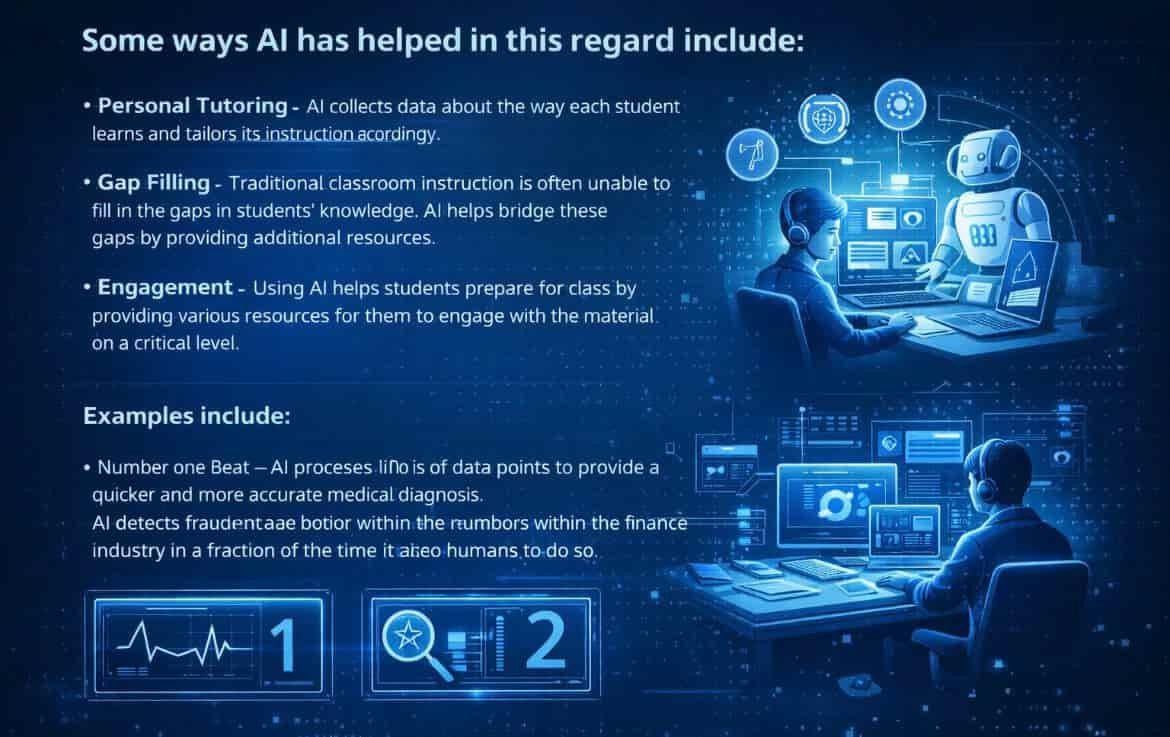
Some ways AI has helped in this regard include:
- Personal Tutoring – AI collects data about the way each student learns and tailors its instruction accordingly. This allows students to learn at their own pace and makes it easier for them to understand and retain difficult concepts.
 Personal Tutoring – AI collects data about the way each student learns and tailors its instruction accordingly. This allows students to learn at their own pace and makes it easier for them to understand and retain difficult concepts.
. Gap Filling – Traditional classroom instruction is often unable to fill in the gaps in students’ knowledge. AI helps bridge these gaps by providing additional resources to aid in completing assigned work.
- Engagement – Using AI helps students prepare for class by providing various resources for them to engage with the material on a critical level.AI also has great potential in
high-pressure industries such as healthcare and finance.
Examples include:
Number one Beat – AI processes millions of data points to provide a quicker and more accurate medical diagnosis. One Beat – AI detects fraudulent behaviour within the finance industry in a fraction of the time it takes humans to do so.
Two Beat – AI enhances human intelligence and gives healthcare and finance professionals the tools to make better-informed, life-saving decisions and to help protect their assets.
The Critical Concerns: Negative Arguments to Consider
To get a complete view of Artificial Intelligence, it’s equally important to understand how AI presents dangers or poses problems.
Here are some examples of danger or problems associated with AI:
- Over dependence: The biggest concern is that people will become lazy in thinking through problems and will just go to AI whenever they need an answer.
- Hallucinations: AI models create what’s called “hallucinations,” in which they fabricate data or make false statements and do so with confidence.
- Verification: It is important that any outputs of AI be verified by someone because students doing a complex task and relying on outputs from AI could get into a lot of trouble. The ethical issues also make up a large portion of the negative arguments associated with AI.
- Data privacy: Copyright concerns created by the use of copyrighted materials for training could create major risk issues.
- Embedded bias: If care is not taken when developing algorithms, they may create discriminatory results.
- Regulatory issues: When data is governed poorly, customer trust is eroded when personal information is shared.
Lastly, there is a psychological/societal impact from:
First Point – Echoes of Reality: The addictive qualities of the AI chatbots and their agreement on everything they say could impede on the ability of people to develop
real-world social skills. First Point – No Challenge: People do not disagree with other people when they use AI; therefore, the user is creating a pleasant place for themselves without any challenges.
Second Point – Social Skills: The preceding reasoning will not allow one to develop the social skills needed to deal with the complexities of relationships with other human beings.
Acceptable Practices for Conscientious Use of Artificial Intelligence
The aforementioned are valid and balanced by the understanding of AI as a tool to enhance one’s ability to reason rather than to replace one’s ability to reason. First Point – Enhance; Don’t Replace – Use AI as a “studying partner” or “coding partner”, not as a replacement for your own ability to reason. First Point – Idea Generation and Refinement – Use AI to generate ideas or bits of writing, but use your own critical thinking ability to improve those ideas.
Second Point – Human Appraisal – Use the output of AI as the basis to conduct human appraisals of the AI output for soundness. Transparency, as mentioned before, is also significant when utilizing AI. First Point – Disclosure – You should disclose when you have used AI and how you have utilized AI, whether you are using AI in business or academia, to maintain integrity. First Point – Critical Thinking – You should engage in critical thinking to verify that AI-generated material can be verified and has predictive validity.
Responsible AI integration: A Focus on context
Second Point – Context of Use – You should ensure that the AI-generated material is contextually relevant to you and to the needs that you have for said material.
Staying informed about changing rules governing artificial intelligence and other aspects of technology means being aware of what you should do based on current trends, which includes: Developing your knowledge base through ongoing educational efforts (e.g., reading articles).
Maintaining your understanding of data usage laws, such as privacy. Identifying and avoiding potential risks associated with artificial intelligence by taking proactive measures.
Being more flexible in your use of artificial intelligence by treating it as a tool rather than a replacement for human decision-making will help minimize the potential risks associated with it and increase the likelihood that you will be able to successfully and successfully leverage it.
To conclude:
Learning to quickly grasp and understand artificial intelligence is not simply about being able to memorize all of the algorithms; rather, it is about establishing a structured body of knowledge that allows you to continually develop and adapt to the changes associated with this rapidly evolving field. In this report, we have examined the five basic principles of artificial intelligence, provided a practical path to learn the basics of AI, and given you a balanced approach to the advantages and disadvantages of this new technology.
This article has discussed how AI is here to stay and will continue to shape our lives in ways most cannot even imagine. The steps detailed above are intended to help you take ownership of your AI experience and not simply be a bystander during the technology revolution. Accept the journey with an open mind, while keeping your ability and willingness to critically analyze information through human intelligence. For additional resources and tools to assist you in this effort, visit ailacenter.tech.
