Introduction
It’s common to hear the words “AI”, “Machine Learning” and “Deep Learning” in conference rooms and marketing. They often seem interchangeable, but understanding the real difference of AI vs Machine Learning vs Deep Learning is simpler than it sounds. Many believe this distinction involves complex coding or mathematics, but that level of difficulty does not exist. Having clarity on how these technologies relate as a hierarchy is a must for anyone navigating today’s tech advancements.
And by the way, that level of difficulty does not exist.
The difference between AI, Machine Learning and Deep Learning is simply about how AI, ML and DL all relate as technologies and to each other, as well as why those relationships matter.
If you are a business owner trying to choose software for your business, create a career path for yourself, or are struggling to keep up with the current technology advancements that exist today, having clarity is a must. Clarity means no jargon (the only true form of profanity) and
no hype (the only thing worse than jargon). Clarity means creating an easy-to-remember mind map of the terms.
By the end of this article, you will learn:
- What is Artificial Intelligence?
- What is Machine Learning and where does it fit within AI?
- Where does Deep Learning fit in?
- What is the Difference between them and how do I confidently communicate this difference in ONE SENTENCE? If you take this information, you will no longer simply understand these terms; you will be able to use these terms properly as well.
What Is Artificial Intelligence?
AI (Artificial Intelligence) is the overarching concept of machines that behave similarly to how an individual would execute actions requiring “intelligence.”
That’s all!
If any machine has the ability to “think,” “make decisions,” or “solve problems” in a like manner to human action, it fits into the category known as AI.
Notice something important about this definition of AI; Artificial Intelligence does NOT refer to Robots, Sci Fi AND/OR Conscious Machines.
AI is simply the application of human intelligence functions by a system to complete a task that would have required human thought processes in order to complete it.
 Some simple examples of AI include (but are not limited to):
Customer Service chatbots that answer customer service inquiries; Google Maps providing directions to the shortest route;
Fraud Detection Systems identifying potentially fraudulent transactions; Voice activated assistants like Siri or Alexa responding to user commands.
So while none of the above systems will “think” like people, all exhibit intelligent behaviours. In Summary of AI
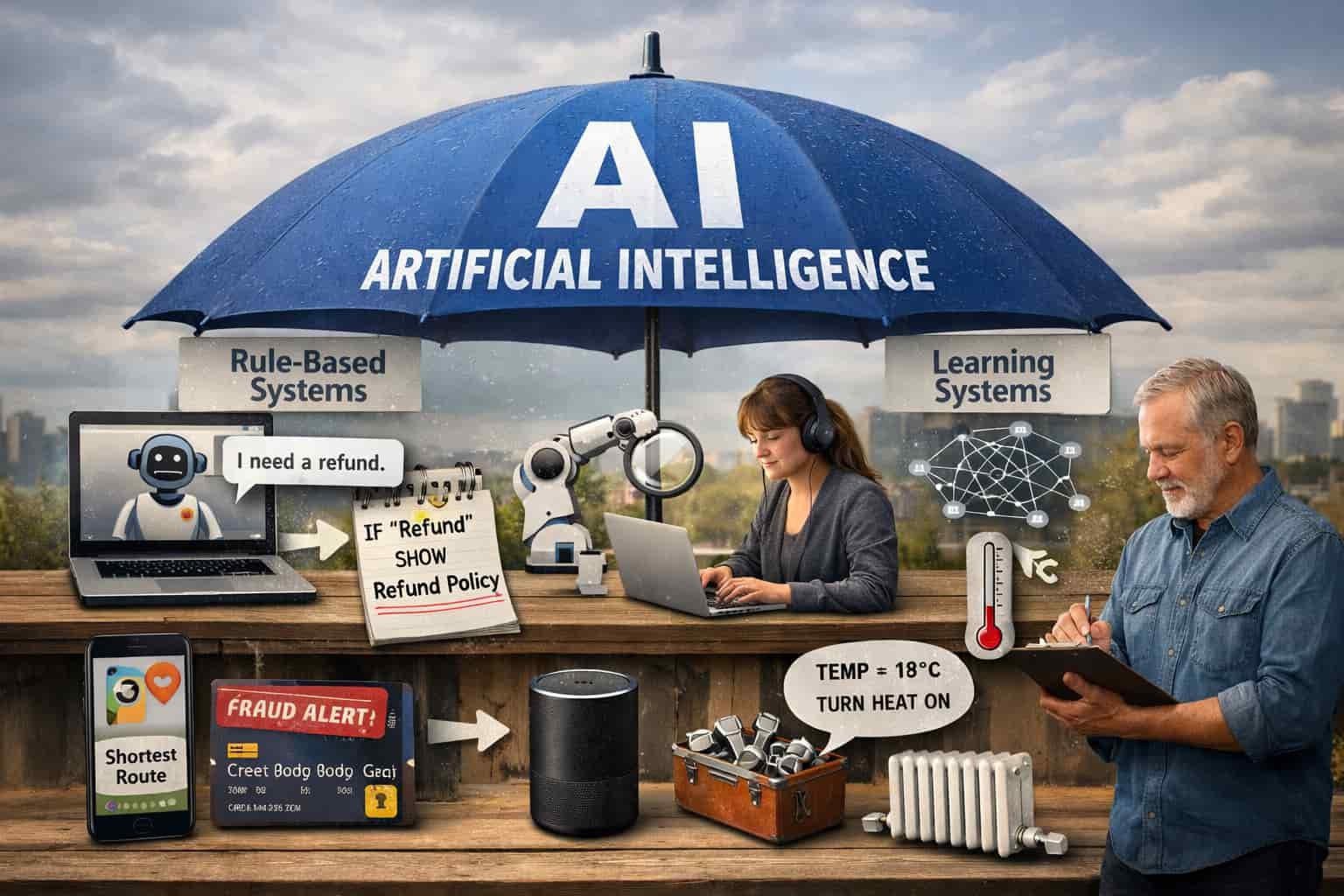
Whenever I’m thinking of AI, I think of it as the umbrella (the large umbrella word) that covers many different types of techniques and approaches, with some being rule-based (where a human writes specific instructions) and others allowing systems to learn from data.
And this is where we’re about to start Windows branching off… Because not every AI system learns.
Some of those first AI systems were all built on rules. For example:
- If a customer says “refund,” the system shows the refund policy
- If the temperature goes below 18 degrees Celsius, the heating will turn on
These two examples are both systems that follow a preset instruction and will only ever get better with the help of an actual person updating them.
What Is Machine Learning?
Machine Learning is one of the branches of Artificial Intelligence.
Machine Learning systems can find patterns in their data instead of having to be programmed with rules explicitly.
Take a moment to read this again.
Traditional Artificial Intelligence can use rules, whereas Machine Learning can learn rules by finding patterns in its data.
This fundamental difference makes the two systems different.
To understand the different ways machines process data, read our guide on Types of Machine Learning: Supervised, Unsupervised & Reinforcement Learning Explained
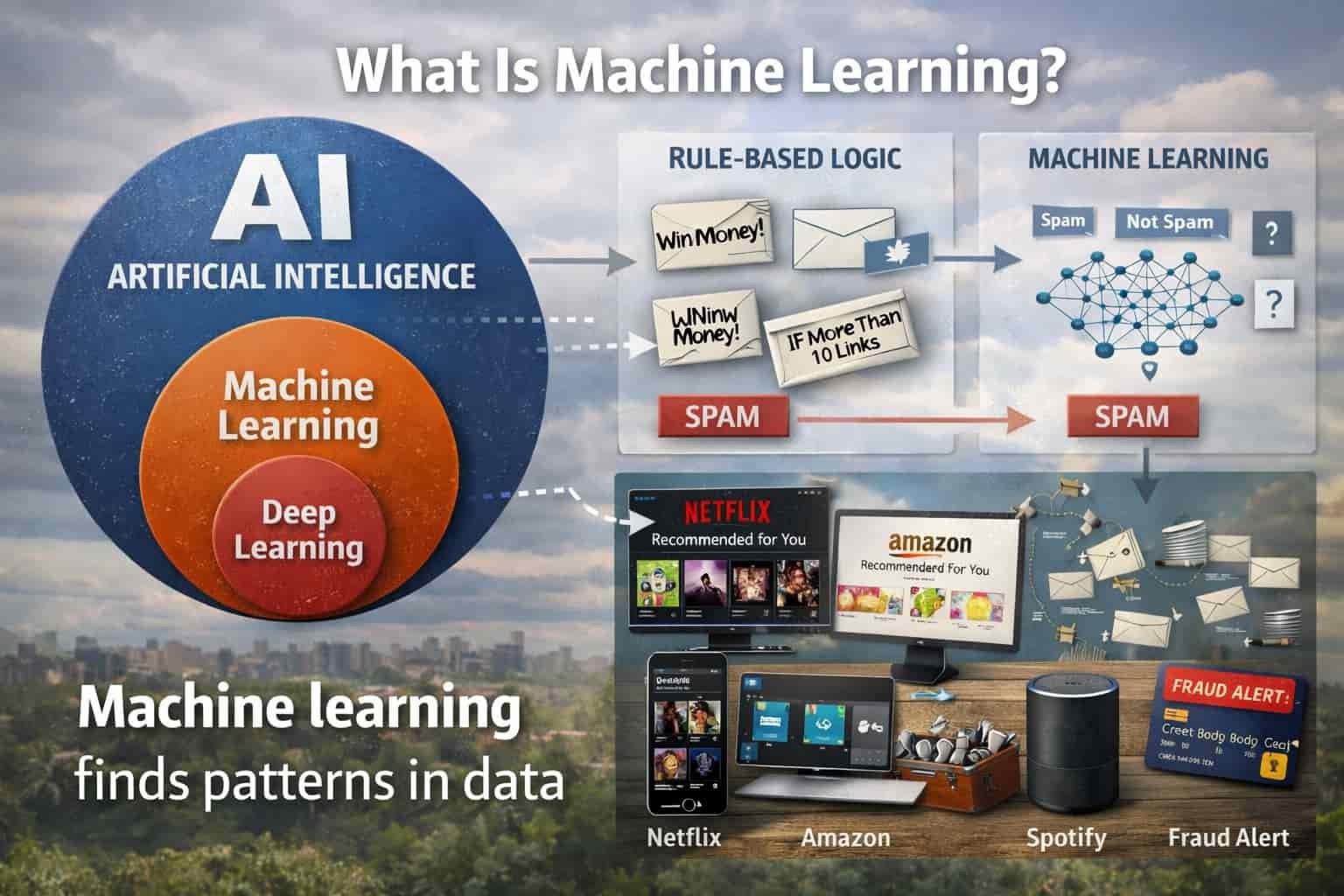
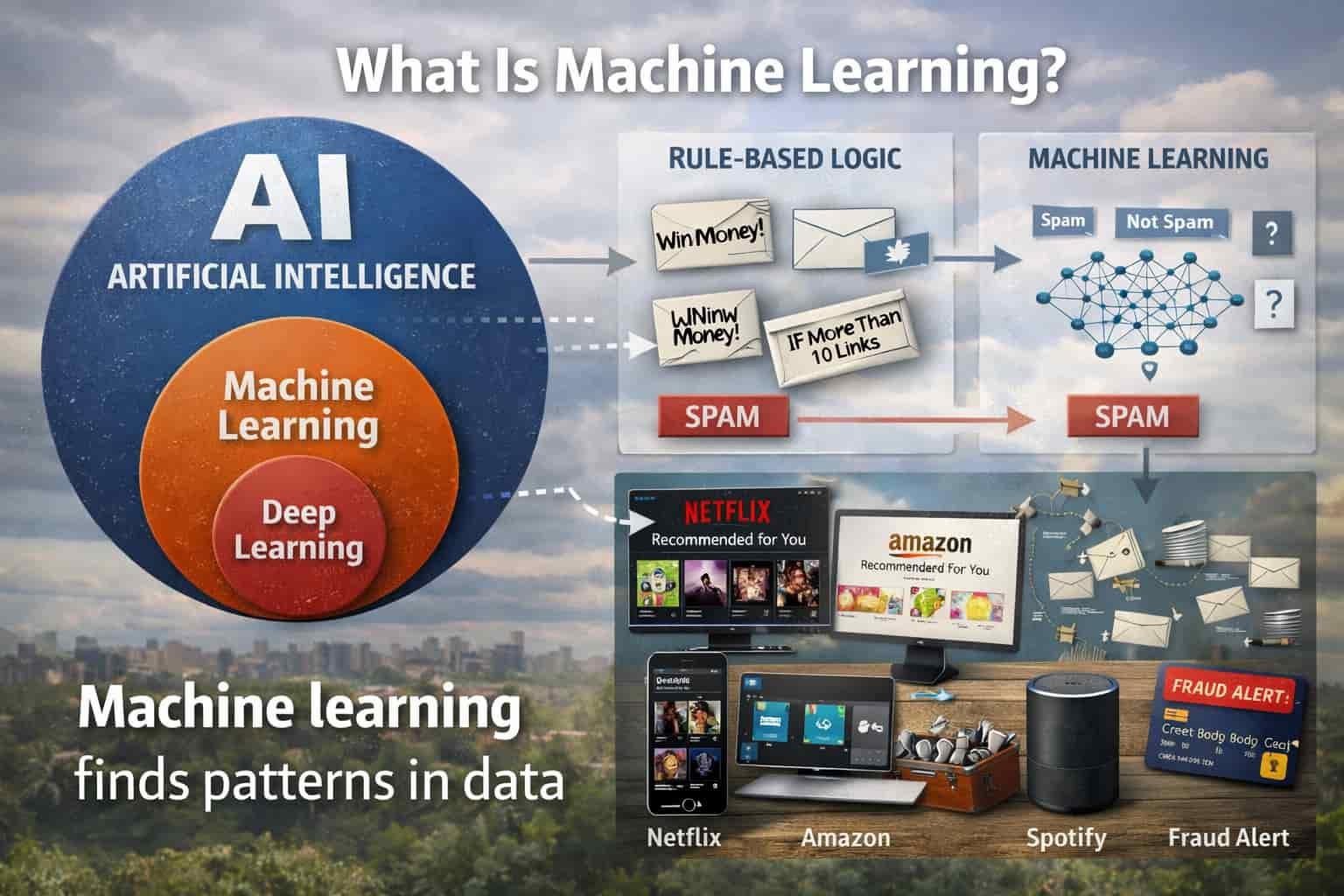
One way to really illustrate this point would be an example of a spam detection system.
If you were using a traditional Artificial Intelligence system to detect spam, you would define a set of rules such as, “If the email says it is ‘winning money,’ mark it as spam,” or “If there are more than 10 links, mark it as spam.”
These rules would allow you to detect spam.
But once the spammers change their language or how many links they include, the system will provide you with incorrect assessments of whether or not an email is spam.
The Machine Learning approach to spam detection is much different.
With a machine- learning system, you would provide the system with several thousand emails already identified as either spam or not spam.
The machine would use the data and its ability to detect patterns to learn what makes an email spam.
You will not give the machine any rules; it learns the rules by finding patterns in the data. That is Machine Learning.
Some examples of Machine Learning in your daily life.
You are using Machine Learning more than you might think. Some examples include:
- Netflix providing you with recommendations based on your viewing habits.
- Amazon making product recommendations.
- Spotify creating playlists tailored to you.

Banks identifying behaviour patterns in their account holders to determine if there are any unusual spending items.
Machine Learning systems will improve over time as they gain access to more data. The importance of machine learning
The machine learning model can automatically learn from your data based on information you feed it. If you wanted to build a program to identify cats in photographs, you could create a huge number of rules that would cover many aspects:
Example Rule #1: A cat has 2 ears Example Rule #2: A cat has whiskers Example Rule #3: A cat has a tail
The problem with creating a set of rules is there are hundreds of different ways every rule can be broken. How do you capture every possible way to specify a cat? You can’t because that would take forever to write all the rules. Machine learning solves this problem by using images of millions of cats from the internet to train an algorithm to identify a cat.
So here is how we can define the relationship of artificial intelligence,
AI is a big concept – machines act smart and do things that require intelligence.
Machine learning is a method through which you get to AI – by learning from data as opposed to following a strict set of predetermined rules.
Now let’s take it one step further.
In machine learning, you have a subset called deep learning, which is much more powerful than machine learning.
What Is Deep Learning?
Deep Learning is part of the machine learning family tree. Artificial Intelligence covers machine learning.
Machine Learning requires Deep Learning, the machine learning subset. Neural networks, inspired by neurophysiology, and used in deep learning.
Don’t worry about the neural networks; you only need to understand how useful they are. Deep learning helps solve very large numbers of problems on unstructured data.
Unstructured data are those that are not presented as rows and columns and examples include:
Pictures Videos Audio/
Natural language (like this story)
Machine learning cannot effectively learn from complex pattern data, whereas deep learning can.
Understanding Deep Learning Let’s revisit the cat example.
With traditional Machine Learning you would typically have to use some of your own knowledge of a cat—its ears, whiskers, shape and texture—to identify the most important characteristics for creating a model to classify images of cats.
However, with Deep Learning there is no need for you to contribute to the identification of characteristics that differentiate cats from other types of animals. This is performed by the
deep learning system itself (known as the neural network) when given a sufficient number (thousands or millions) of images to analyze.
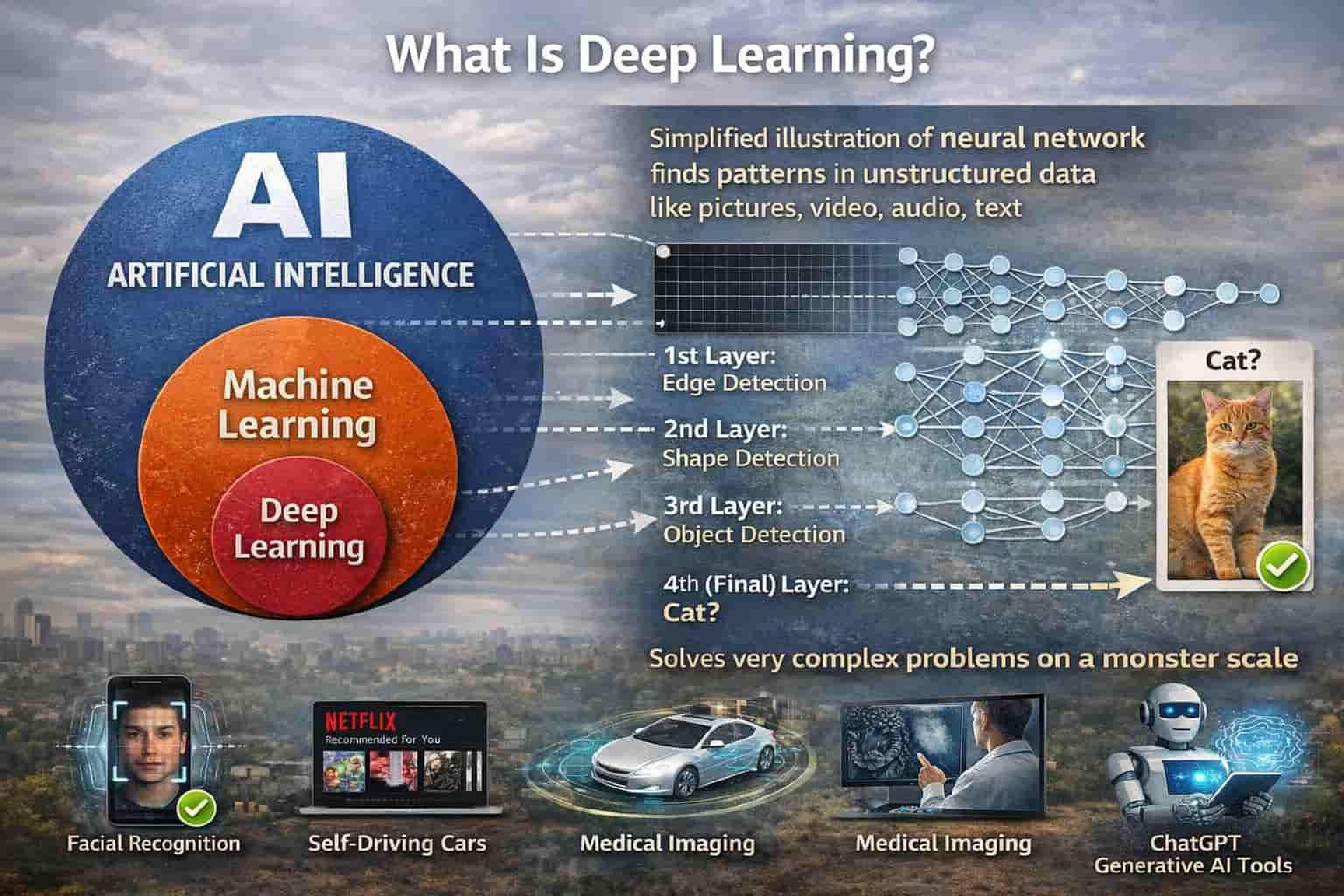
The ‘deep’ component of Deep Learning comes from the number of layers within the neural network itself and the fact that each layer is capable of identifying progressively better representations.
For example:
1st layer = edge detection, 2nd layer = shape detection, 3rd layer = object detection,
4th (and last) layer = Determining if the object is actually a cat .
Now, if the above four processes were to be performed manually you could process thousands of images per hour in less than a day.
Deep Learning is being utilized in some of the most sophisticated artificial intelligence systems today:
Facial recognition systems Self driving car vision systems
Voice-enabled assistants that can interpret human speech
Medical Imaging
Generative AI tools (including ChatGPT)
These solutions require a large quantity of data and extensive computing resources; however, they produce very accurate outputs.
Why Deep Learning seems “advanced”
Deep Learning can deal with really complex things on a monster scale.
But there are other areas of technology where Deep Learning isn’t really “better” than another approach.
Some of the reasons include:
Large amounts of data are needed by Deep Learning systems The level of computation power required is massive.
Interpreting results using Deep Learning can be very difficult compared to other methods.
If you are using machine learning for a typical business-type application, normal machine learning can be a better option. The point is now that you can clearly see how everything fits together:
Artificial Intelligence = the larger goal
Machine Learning = one way to achieve artificial intelligence by learning from data Deep Learning = a specialized subset of machine learning based on neural networks. Now let me make this even easier for you to remember.
The Simple Relationship Explained: AI vs Machine Learning vs Deep Learning
Key takeaways:
Deep Learning: part of Machine Learning Machine Learning: part of Artificial Intelligence
That hierarchy represents the relationships between each term.
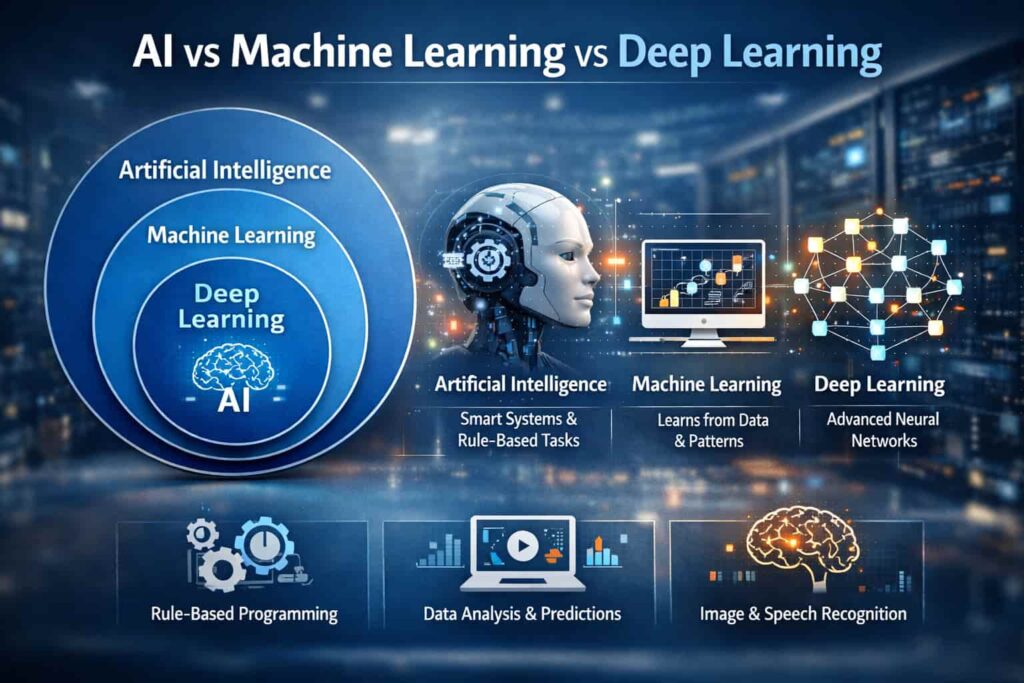
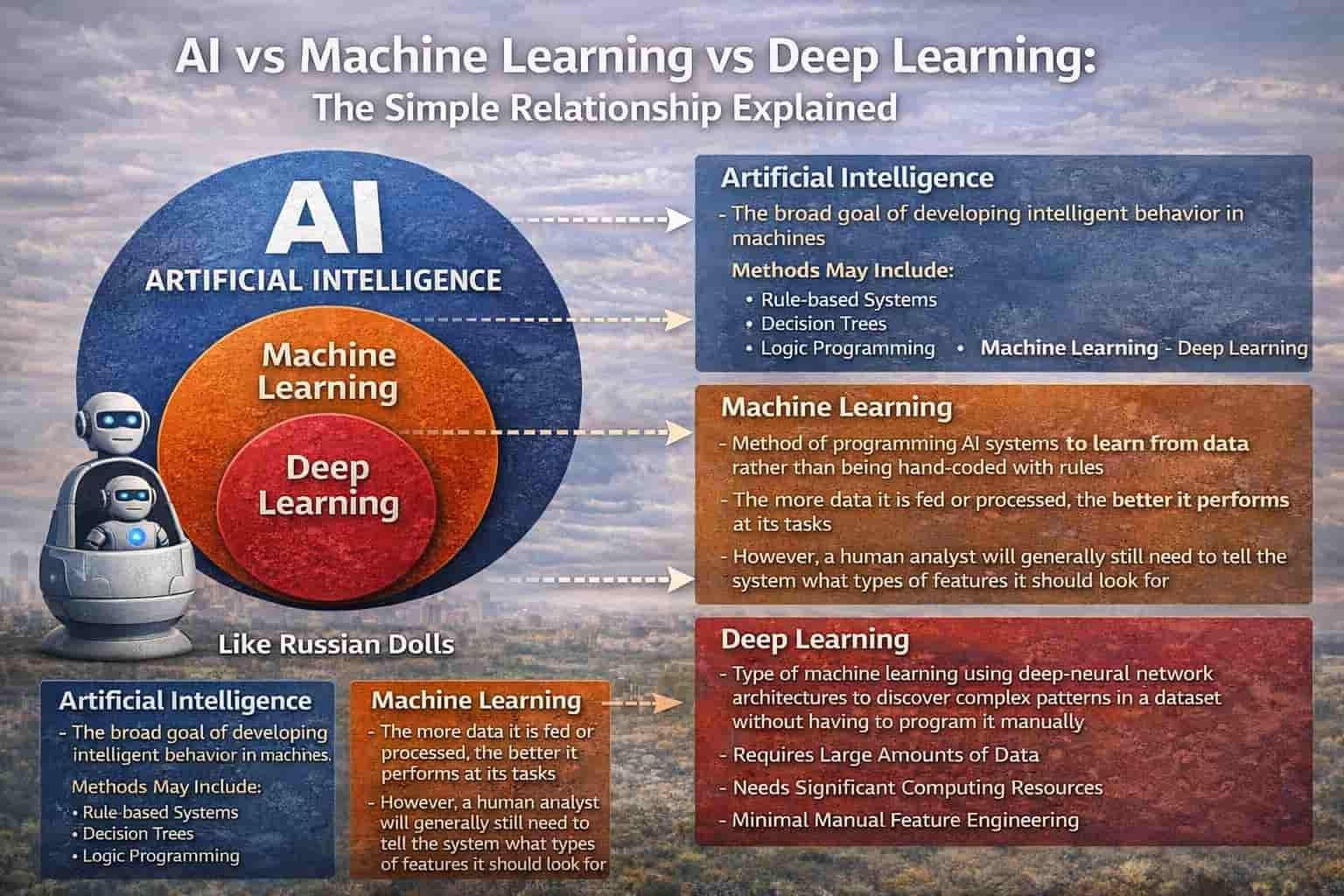
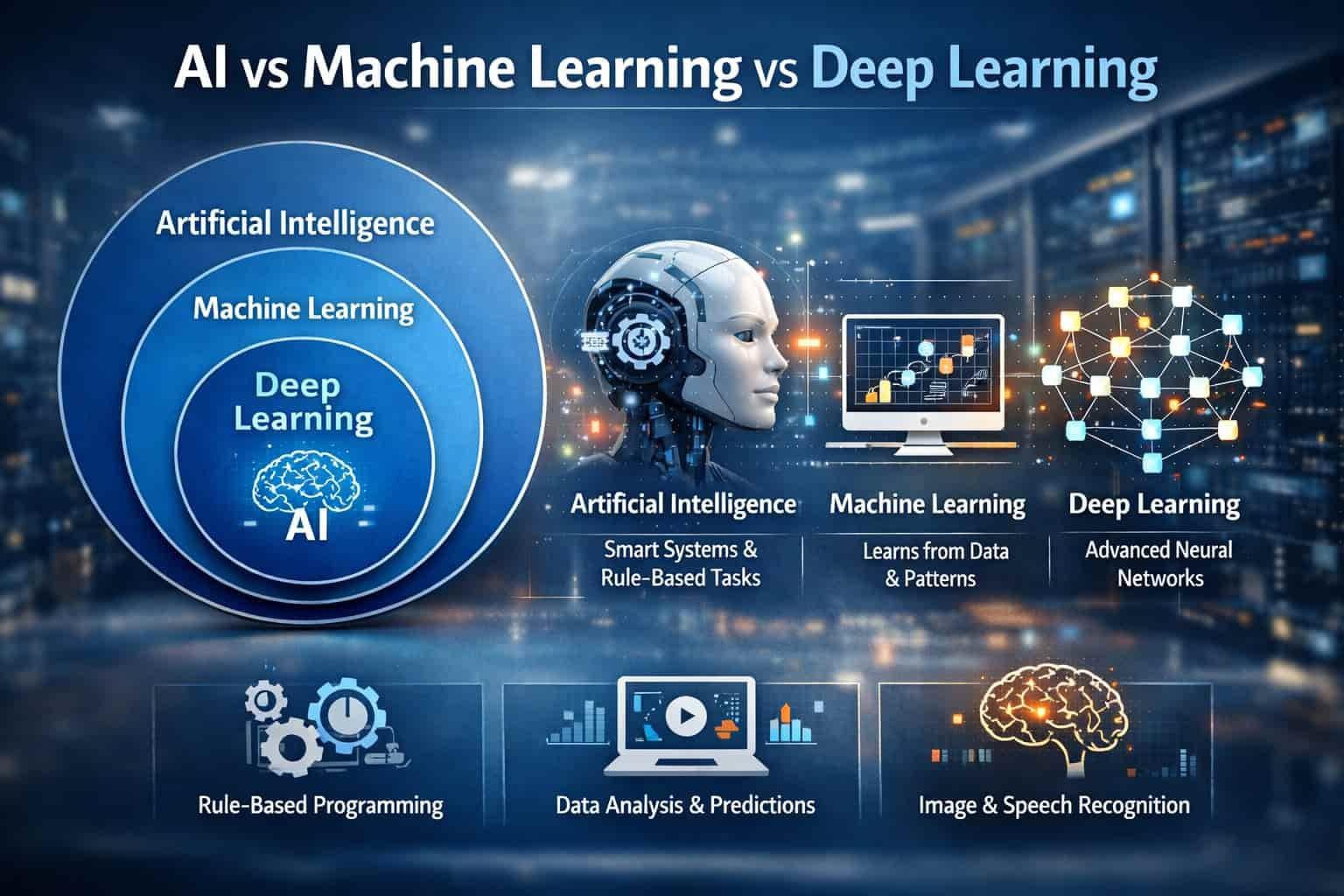
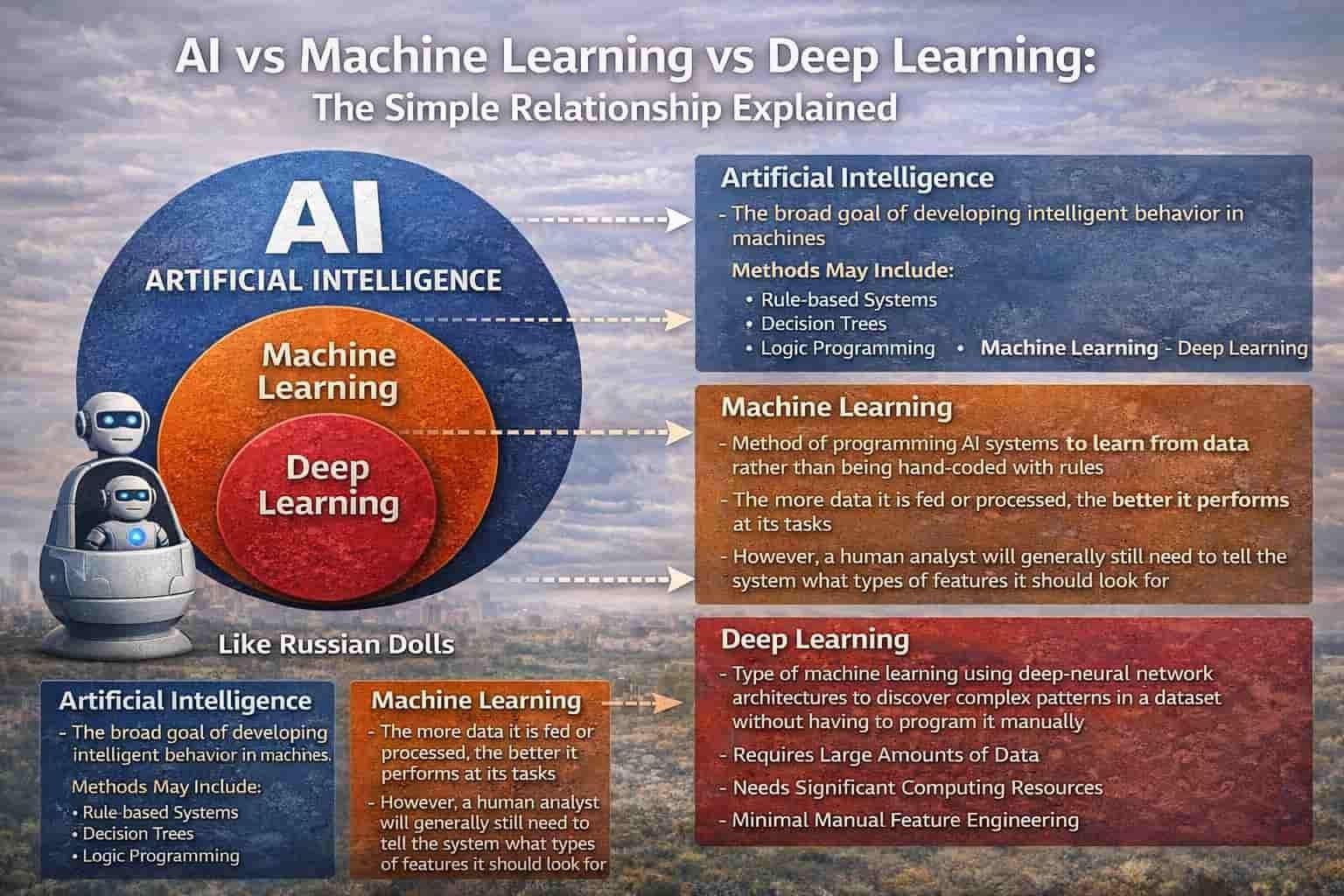
To visualize this relationship is three nested circles – Artificial Intelligence, Machine Learning, and Deep Learning.
You can also think of this as Russian dolls, where each subsequent term fits within the previous term.
Definitions for each are provided below:
Artificial Intelligence
The broad goal of developing intelligent behavior in machines. Methods may include:
Rule-based systems Decision Trees Logic programming Machine Learning Deep Learning
Not all instances of AI are such that they learn.
Machine Learning
Method of programming AI systems to learn from data rather than being hand-coded with rules.
The more data it is fed or processed, the better it performs at its tasks.
However, a human analyst will generally still need to tell the system what types of features it should look for.
Deep Learning
A type of Machine Learning using deep-neural network architectures to discover complex patterns in a dataset dataset without having to program it manually.
Deep Learning requires:
Large amounts of data Significant computing resources
Minimal Manual Feature Engineering
Why people mix them up
 Why people mix them up
Most of the sophisticated AI solutions (aka machine intelligence) that have developed over the last few decades are based on machine-learning principles, and many of the recent, mainstream breakthroughs in AI can be attributed to advances in deep-learning technology.
Thus, when someone claims to be using “AI” to describe a product or service offer, they may really be referring either to machine learning or to deep learning.
A few representative examples include:
- when a business uses the term “AI-driven analytics,” they typically mean machine learning
- when an individual discusses a generative AI application, they likely mean a deep-learning model
Even though we use the terms loosely throughout our daily interactions, the two concepts are not synonymous in a technical sense. You should appreciate and acknowledge this distinction between them, as it can have significant implications for your technology investment decisions (hiring decisions) and your evaluation of third-party software applications. Having clarity on the two terms provides you with better decision-making capability.
AI vs Machine Learning vs Deep Learning
Introduction
It’s common to hear the words “AI”, “Machine Learning” and “Deep Learning” in conference rooms, newspapers and in marketing. They often seem interchangeable and, at times, the terms can appear to mean completely different things.
If you’re like most people, you think that it’s about time you knew the distinction between them.
The problem with understanding what these terms mean is that audio/video explanations make it sounds more difficult than it is.
Because of this, it’s possible that many people think understanding the difference between AI, Machine Learning and Deep Learning involves learning how to program/code, mathematics or another level of complexity.
And by the way, that level of difficulty does not exist.
The difference between AI, Machine Learning and Deep Learning is simply about how AI, ML and DL all relate as technologies and to each other, as well as why those relationships matter.
If you are a business owner trying to choose software for your business, create a career path for yourself, or are struggling to keep up with the current technology advancements that exist today, having clarity is a must. Clarity means no jargon (the only true form of profanity) and
no hype (the only thing worse than jargon). Clarity means creating an easy-to-remember mind map of the terms.
By the end of this article, you will learn:
- What is Artificial Intelligence?
- What is Machine Learning and where does it fit within AI?
- Where does Deep Learning fit in?
- What is the Difference between them and how do I confidently communicate this difference in ONE SENTENCE? If you take this information, you will no longer simply understand these terms; you will be able to use these terms properly as well.
What Is Artificial Intelligence?
AI (Artificial Intelligence) is the overarching concept of machines that behave similarly to how an individual would execute actions requiring “intelligence.”
That’s all!
If any machine has the ability to “think,” “make decisions,” or “solve problems” in a like manner to human action, it fits into the category known as AI.
Notice something important about this definition of AI; Artificial Intelligence does NOT refer to Robots, Sci Fi AND/OR Conscious Machines.
AI is simply the application of human intelligence functions by a system to complete a task that would have required human thought processes in order to complete it.
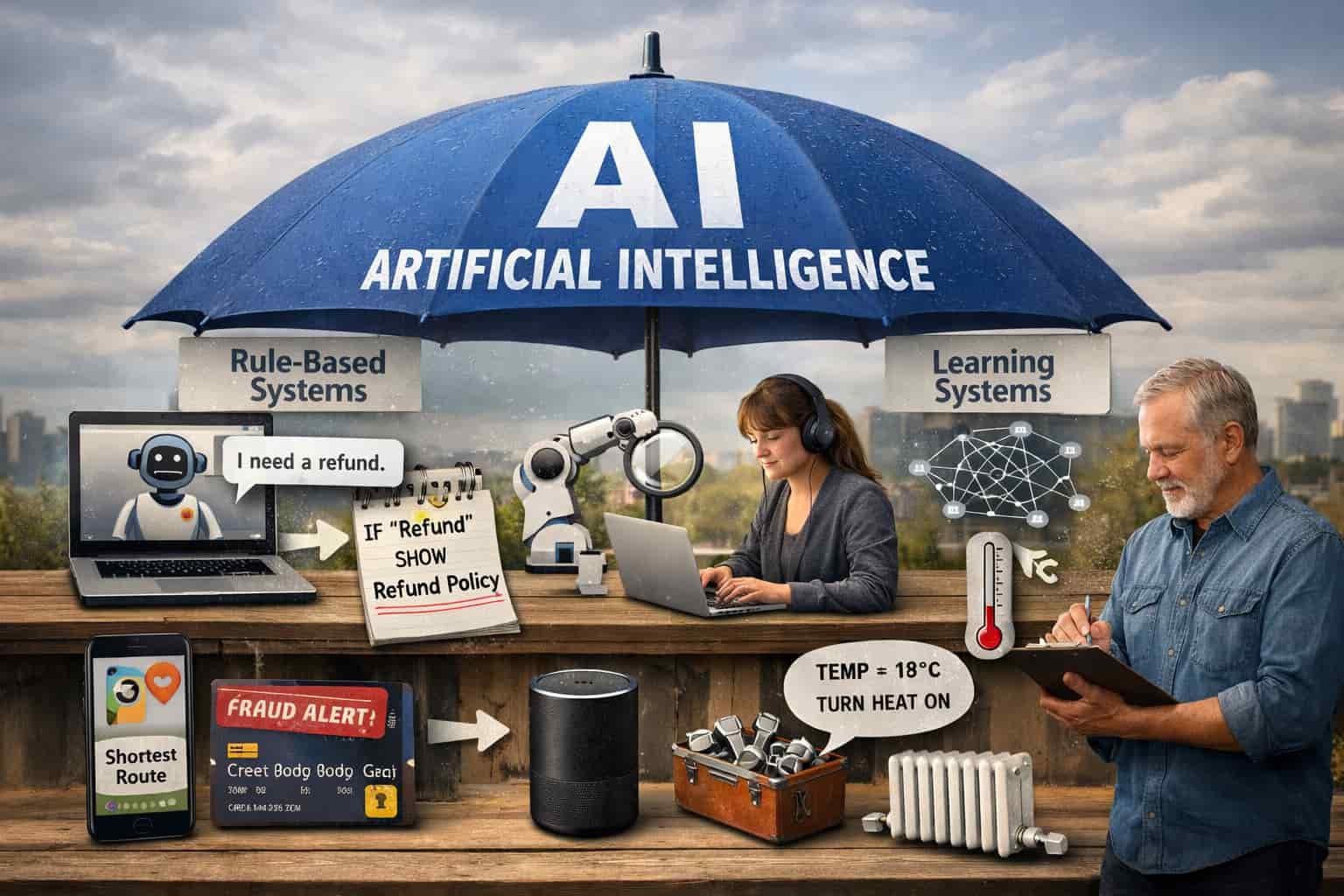 Some simple examples of AI include (but are not limited to):
Customer Service chatbots that answer customer service inquiries; Google Maps providing directions to the shortest route;
Fraud Detection Systems identifying potentially fraudulent transactions; Voice activated assistants like Siri or Alexa responding to user commands.
So while none of the above systems will “think” like people, all exhibit intelligent behaviours. In Summary of AI
Whenever I’m thinking of AI, I think of it as the umbrella (the large umbrella word) that covers many different types of techniques and approaches, with some being rule-based (where a human writes specific instructions) and others allowing systems to learn from data.
And this is where we’re about to start Windows branching off… Because not every AI system learns.
Some of those first AI systems were all built on rules. For example:
- If a customer says “refund,” the system shows the refund policy
- If the temperature goes below 18 degrees Celsius, the heating will turn on
These two examples are both systems that follow a preset instruction and will only ever get better with the help of an actual person updating them.
What Is Machine Learning?
Machine Learning is one of the branches of Artificial Intelligence.
Machine Learning systems can find patterns in their data instead of having to be programmed with rules explicitly.
Take a moment to read this again.
Traditional Artificial Intelligence can use rules, whereas Machine Learning can learn rules by finding patterns in its data.
This fundamental difference makes the two systems different.
One way to really illustrate this point would be an example of a spam detection system.If you were using a traditional Artificial Intelligence system to detect spam, you would define a set of rules such as, “If the email says it is ‘winning money,’ mark it as spam,” or “If there are more than 10 links, mark it as spam.”
These rules would allow you to detect spam.
But once the spammers change their language or how many links they include, the system will provide you with incorrect assessments of whether or not an email is spam.
The Machine Learning approach to spam detection is much different.
With a machine- learning system, you would provide the system with several thousand emails already identified as either spam or not spam.
The machine would use the data and its ability to detect patterns to learn what makes an email spam.
You will not give the machine any rules; it learns the rules by finding patterns in the data. That is Machine Learning.
Some examples of Machine Learning in your daily life.
You are using Machine Learning more than you might think. Some examples include:
- Netflix providing you with recommendations based on your viewing habits.
- Amazon making product recommendations.
- Spotify creating playlists tailored to you.
Banks identifying behaviour patterns in their account holders to determine if there are any unusual spending items.
Machine Learning systems will improve over time as they gain access to more data. The importance of machine learning
The machine learning model can automatically learn from your data based on information you feed it. If you wanted to build a program to identify cats in photographs, you could create a huge number of rules that would cover many aspects:
Example Rule #1: A cat has 2 ears Example Rule #2: A cat has whiskers Example Rule #3: A cat has a tail
The problem with creating a set of rules is there are hundreds of different ways every rule can be broken. How do you capture every possible way to specify a cat? You can’t because that would take forever to write all the rules. Machine learning solves this problem by using images of millions of cats from the internet to train an algorithm to identify a cat.
So here is how we can define the relationship of artificial intelligence,
AI is a big concept – machines act smart and do things that require intelligence.
Machine learning is a method through which you get to AI – by learning from data as opposed to following a strict set of predetermined rules.
Now let’s take it one step further.
In machine learning, you have a subset called deep learning, which is much more powerful than machine learning.
What Is Deep Learning?
Deep Learning is part of the machine learning family tree. Artificial Intelligence covers machine learning.
Machine Learning requires Deep Learning, the machine learning subset. Neural networks, inspired by neurophysiology, and used in deep learning.
Don’t worry about the neural networks; you only need to understand how useful they are. Deep learning helps solve very large numbers of problems on unstructured data.
Unstructured data are those that are not presented as rows and columns and examples include:
Pictures Videos Audio/
Natural language (like this story)
Machine learning cannot effectively learn from complex pattern data, whereas deep learning can.
Understanding Deep Learning Let’s revisit the cat example.
With traditional Machine Learning you would typically have to use some of your own knowledge of a cat—its ears, whiskers, shape and texture—to identify the most important characteristics for creating a model to classify images of cats.
However, with Deep Learning there is no need for you to contribute to the identification of characteristics that differentiate cats from other types of animals. This is performed by the
deep learning system itself (known as the neural network) when given a sufficient number (thousands or millions) of images to analyze.
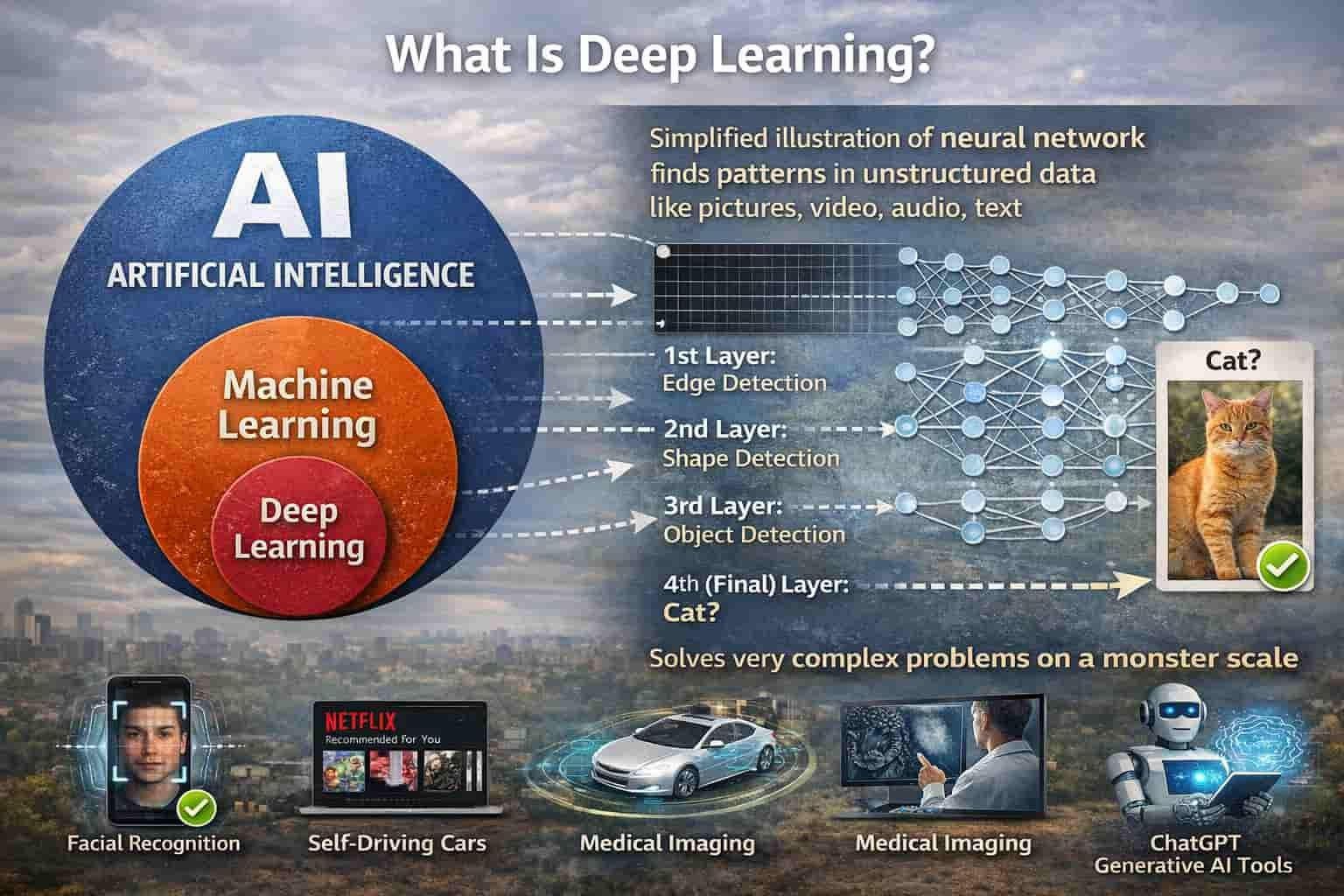
The ‘deep’ component of Deep Learning comes from the number of layers within the neural network itself and the fact that each layer is capable of identifying progressively better representations.
For example:
1st layer = edge detection, 2nd layer = shape detection, 3rd layer = object detection,
4th (and last) layer = Determining if the object is actually a cat .
Now, if the above four processes were to be performed manually you could process thousands of images per hour in less than a day.
Deep Learning is being utilized in some of the most sophisticated artificial intelligence systems today:
Facial recognition systems Self driving car vision systems
Voice-enabled assistants that can interpret human speech
Medical Imaging
Generative AI tools (including ChatGPT)
These solutions require a large quantity of data and extensive computing resources; however, they produce very accurate outputs.
Why Deep Learning seems “advanced”
Deep Learning can deal with really complex things on a monster scale.
But there are other areas of technology where Deep Learning isn’t really “better” than another approach.
Some of the reasons include:
Large amounts of data are needed by Deep Learning systems The level of computation power required is massive.
Interpreting results using Deep Learning can be very difficult compared to other methods.
If you are using machine learning for a typical business-type application, normal machine learning can be a better option. The point is now that you can clearly see how everything fits together:
Artificial Intelligence = the larger goal
Machine Learning = one way to achieve artificial intelligence by learning from data Deep Learning = a specialized subset of machine learning based on neural networks. Now let me make this even easier for you to remember.
The Simple Relationship Explained: AI vs Machine Learning vs Deep Learning
Key takeaways:
Deep Learning: part of Machine Learning Machine Learning: part of Artificial Intelligence
That hierarchy represents the relationships between each term.
To visualize this relationship is three nested circles – Artificial Intelligence, Machine Learning, and Deep Learning.
You can also think of this as Russian dolls, where each subsequent term fits within the previous term.
Definitions for each are provided below:
Artificial Intelligence
The broad goal of developing intelligent behavior in machines. Methods may include:
Rule-based systems Decision Trees Logic programming Machine Learning Deep Learning
Not all instances of AI are such that they learn.
Machine Learning
Method of programming AI systems to learn from data rather than being hand-coded with rules.
The more data it is fed or processed, the better it performs at its tasks.
However, a human analyst will generally still need to tell the system what types of features it should look for.
Deep Learning
A type of Machine Learning using deep-neural network architectures to discover complex patterns in a dataset dataset without having to program it manually.
Deep Learning requires:
Large amounts of data Significant computing resources
Minimal Manual Feature Engineering
Why people mix them up
 Why people mix them up
Most of the sophisticated AI solutions (aka machine intelligence) that have developed over the last few decades are based on machine-learning principles, and many of the recent, mainstream breakthroughs in AI can be attributed to advances in deep-learning technology.
Thus, when someone claims to be using “AI” to describe a product or service offer, they may really be referring either to machine learning or to deep learning.
A few representative examples include:
- when a business uses the term “AI-driven analytics,” they typically mean machine learning
- when an individual discusses a generative AI application, they likely mean a deep-learning model
Even though we use the terms loosely throughout our daily interactions, the two concepts are not synonymous in a technical sense. You should appreciate and acknowledge this distinction between them, as it can have significant implications for your technology investment decisions (hiring decisions) and your evaluation of third-party software applications. Having clarity on the two terms provides you with better decision-making capability.

Author: AI Learner Tech
AI Learner Tech is a premier research and educational hub dedicated to mastering Artificial Intelligence, Machine Learning, and Computer Vision. We bridge the gap between complex academic theories and real-world industrial applications. Join our community to access high-quality tutorials, open-source projects, and expert insights. Website: ailearner.tech