
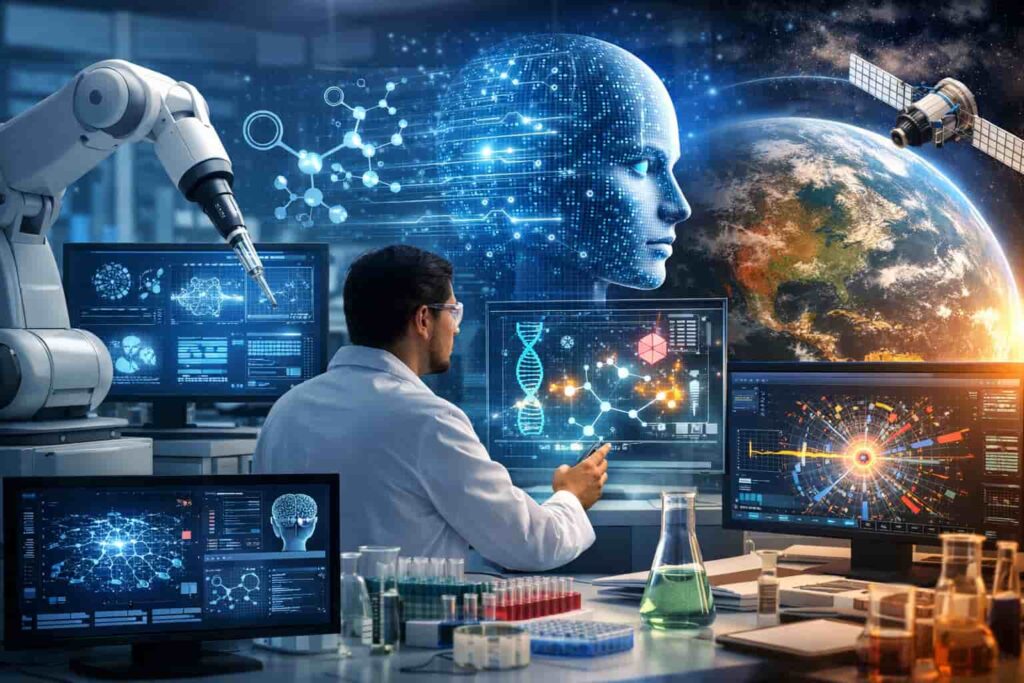
How AI is Revolutionizing Scientific Research in 2026
Is it just me, or have you noticed all of the recent breakthroughs are going on around the topic of Artificial Intelligence? I mean new cancer treatments, faster climate modeling, and materials being discovered in just a few weeks all pretty much seem like they could have happened 20 years from now without AI technology. So if you’re anything like me, you might be both very impressed by what’s happening with AI in Scientific Research, however at the same time very sceptical on whether AI is actually making a significant difference for the life sciences in 2026, or if it’s simply creative automation dressed up as if it’s something revolutionary.
The reason why you’re witnessing this tremendous shift now isn’t hype; it’s a major paradigm change to the way that scientific discovery happens as a result of AI based assistance becoming a discovery engine that is capable of generating hypotheses, predicting future outcomes and guiding the experiments. The move from helpful assistant to discovery engine is one of the most fundamental shifts in the way scientific research occurs.
So for those of you working in any form of research, innovation or technology, as well as for people concerned with policy, this has significant implications to you. As you can see, AI is not on the sidelines anymore; AI is now widely adopted and used in virtually all fields of research, innovation, technology and government. AI is shortening timelines, changing budgets and redefining what it means to be a scientist on a day to day basis.
This article provides an overview of how AI is revolutionizing scientific research in 2026. It covers the major breakthroughs occurring with AI, how AI assists in rapidly bringing discoveries to fruition, and whether scientists are being replaced by or adding to their ability to create and develop ideas. Additionally, it covers any associated risks of using AI in
conducting research and offers the reader an understanding of the implications of AI in the field of scientific research after reading through it.
 From Data Analysis to Discovery Engines
 From Data Analysis to Discovery Engines
AI in Scientific Research has changed from providing assistance with analysis and answering previously posed hypotheses to proactively generating new hypotheses and identifying research areas that were never considered. An example of this is in identifying patterns within a large body of data. A human researcher may take months to evaluate thousands of data points, while AI has the ability to process millions in a matter of hours. In some cases, this number of data points may make the difference between incremental versus revolutionary progress (e.g., genomics, not only making progress in uncovering knowledge about the human genome but through particle physics (e.g. discovery of antimatter and the God particle) and through epidemiology (e.g., identifying connections in the spread of disease)).However, the key difference between today’s researchers and past researchers is not just how quickly we can generate data but how we generate hypotheses. A new generation of artificial intelligence systems enables researchers to simulate complex systems; virtually test variables; and evaluate which variables will produce the most successful outcomes before engaging in any physical experimentation. As a result, scientists will spend far less time pursuing unfruitful research pathways than they have in the past because they will have access to reliable information.
There may be a concern that AI will remove creativity from scientific discovery. On the contrary, AI allows scientists to concentrate on interpreting the results of their work, assessing their work with respect to ethical issues, thinking strategically about the future, and so on. In other words, AI acts as an enabler of the scientist by allowing them to operate
differently than they have in the past. Scientists will no longer be primarily engaged with large-scale data analysis, but instead will focus on being better strategic thinkers.
As such, 2026 will look very different from 2021. Scientists will be generating hypotheses faster than ever; the AI in Scientific Research will act as a discovery tool rather than an auxiliary tool, resulting in much more focused discovery, predictive in nature rather than exploratory, and significantly reduced reliance on trial and error.
The next section contains additional information that will help to clarify the changes that can be expected. Please see Section 4 for more information about what will happen in the future.
AI in Drug Discovery and Medicine

One of the most obvious examples of how AI is impacting people’s lives in 2026 is within medicine, specifically regarding drug development.
In the past, it typically took between 10 and 15 years for a new drug to be developed and cost the developer billions of dollars—and most of the compounds never worked, with the majority of design concepts being screened out during clinical trials. There were a large number of variables making drug development a time-consuming, costly and speculative endeavour.
With AI in Scientific Research, this process has been shortened significantly, because of the use of machine learning algorithms to search through millions of chemical compounds in a matter of days and predict which of those molecules are most likely to bind to a designated target protein. This allows researchers to start with a much shorter list of compounds to test in laboratories than in the past, providing years of time savings.
DeepMind is one such company that has helped drive tremendous advancements in drug development through their $100 million investment in AlphaFold. AlphaFold is an advanced artificial intelligence programme that can predict the three-dimensional structure of proteins with nearly experimental accuracy. Individual protein folding has been a challenge for researchers since protein layout originally became a scientific reality. With an enormous wealth of protein folding data gained via AlphaFold, researchers are now able to access a wide range of structural information that will allow them to design vaccines, study rare diseases, and develop targeted therapies much faster than was previously possible.
In terms of cancer treatment, machine learning methods are allowing for more personalised approaches to therapies rather than the traditional one-size-fits-all approach. Specifically, researchers can now analyse the genetic information and tumour characteristics of each patient to optimise the therapy chosen for them based on predicted efficacy and thereby reduce the amount of unnecessary trial-and-error for patients and ultimately improve their chance of survival.The way we are conducting Clinical Trials is changing too; previously, finding the right patients to recruit into a clinical trial was time-consuming and inefficient.
However, with AI being used in Scientific Research, algorithms will be able to analyze large amounts of health data, including medical records, genetic markers, and lifestyle choices, and identify the best-suited individuals much faster than before. Therefore, clinical trials will run more smoothly, allowing for products to be brought to market sooner.
When it comes to whether or not AI can actually design drugs by itself, the answer is that it cannot fully do so at this time. Human input will remain an important and integral part of the drug development process. Nevertheless, AI will be able to create and provide candidate molecules for drugs, predict the side effects, and identify the potential risks associated with toxicity prior to any animal or human testing of the drug being conducted; additionally, scientists will be able to verify and refine any of the outputs created by Artificial Intelligence. This is collaboration rather than replacement.
As a result of these changes, by the year 2026, drug development will no longer be strictly done in an experimental manner, as seen through traditional methods. The entire process from development to the patient being matched to a particular clinical trial will now be driven by AI, thus making the drug development process much more predictive, dynamic, personalized, and efficient compared to how it has been historically.
Climate Science and Environmental Modelling
The scale of climate science has always posed challenges. This challenge is intensified when it comes to modeling the oceans, forests, ice sheets, atmospheric chemistry, and decades of historical data. Modeling the climate system is a complex, interrelated system that is continually changing. In 2026, this is precisely why the use of Artificial Intelligence (AI) in Scientific Research is proving to be invaluable to climate modeling.
Traditional Models are physics-based models that require supercomputers weeks to perform their calculations. Due to AI in Scientific Research, these models have been augmented by AI’s ability to learn from large data sets, providing quicker, high-resolution forecasts of
 climate change. Using AI has significantly reduced the time required to perform simulations of the climate system.
Researchers working with organizations such as NASA and the European Space Agency have combined machine learning with satellite imagery to track deforestation, the melting of polar ice, and changing ocean temperatures in near real-time rather than waiting months for a comprehensive report. The fact that scientists can now identify these changes in the environment as they occur demonstrates the strength of AI in Scientific Research on a global scale.
The precision of predicting severe weather is also becoming more accurate. AI models utilize past storm data, ocean temperatures, and atmospheric conditions to provide much more accurate predictions for hurricanes and floods. By 2026, AI in Scientific Research will provide earlier preparation for governments, provide better allocation of resources, and reduce the damage that natural disasters cause.
The actual change has been in the creation of models of possible scenarios. Policymakers now have a need not just to understand what is happening but to develop an understanding of what could happen should different emissions strategies be used. AI in Scientific Research can run thousands of possibilities related to any given strategy and provide policymakers with a clearer understanding of the long-term impact of their decisions.
Some folks may be skeptical of the dependability of predicting climate via an AI model; this is reasonable as the ability to predict climate can impact global economies and global policy. In practice, however, AI in Scientific Research does not replace traditional physics modelling, it just provides additional capabilities. Scientists verify AI modelling results with additional data, verify findings against historical data, and maintain transparency regarding the methods used to build the models.
The bottom line is that AI in Scientific Research will permit researchers and governments to anticipate and mitigate environmental damage much sooner in 2026 than prior years—allowing for much greater overall protection against the impacts of climate change and natural disaster.
Physics, Materials Science, and the Search for New Theories
 Physics, Materials Science, and the Search for New Theories
Medicine demonstrates the practical implementation of AI for scientific research; however, physics and materials science demonstrate its intellectual implementation. The basis for physics and materials science is complex mathematics, extremely large amounts of data/information and theories that may take decades to establish. By 2026, AI has advanced from merely assisting scientists with calculations to also providing scientists with insights into patterns that may have previously been unseen.
For example, particle physicists generate vast quantities of data with each collision they create when running experiments. Given the huge volume of information produced as a result of these experiments, physicists are not able to conduct all of the data analysis by hand. With the assistance of AI in scientific research, an AI algorithm can process the information generated from particle collision experiments at the same time as the event is happening. This allows physicists to not drown in data, but instead focus on analysing the anomalies in the experiment with the highest probability of discovering new particles or rare interaction.
The implementation of AI technology in materials science is even more pronounced. In the past, it took years of experimentation in the laboratory for physicists to discover new materials. Today, AI can predict how a variety of atomic combinations will behave prior to actual experimentation with those combinations. Among other attributes, physicists can simulate atomic combinations for physical properties such as conductivity, strength, heat resistance and flexibility; therefore, reducing the amount of time and cost associated with conducting repeated search for new materials due to trial and error methodologies.
The ability to predict how a material will behave through modelling is increasing the rate of innovation related to materials used in batteries and semiconductor materials as well as renewable energy materials due to the AIs ability in scientific research to limit the number of combinations to be tested based on predictions.
How can AI aid in generating theories? The use of AI in scientific research is providing assistance to researchers who are working to identify mathematical relationships found in chaotic complex systems around the globe. Some AI-based models have been able to
re-discover various natural laws; however, they did not understand them as a human would have understood them. They simply detected patterns present in an otherwise unorganized set of data.
By 2026, the AI technology that is used for scientific research is no longer simply a computationally efficient means of working; it is serving as an equal partner in generating new theories. While scientists continue to interpret the results of their experiments, determine if their assumptions were correct and what conceptual framework to use, AI is working more frequently to highlight potential relationships that should be explored.
The result of these advances is that physics and materials science research cycles are being shortened. Discovery is becoming more directed, and researchers are using AI as a catalyst to explore and push further out the boundaries of both what can be done experimentally and theoretically.
Autonomous Labs and Self-Driving Experiments
 Autonomous Labs and Self-Driving Experiments
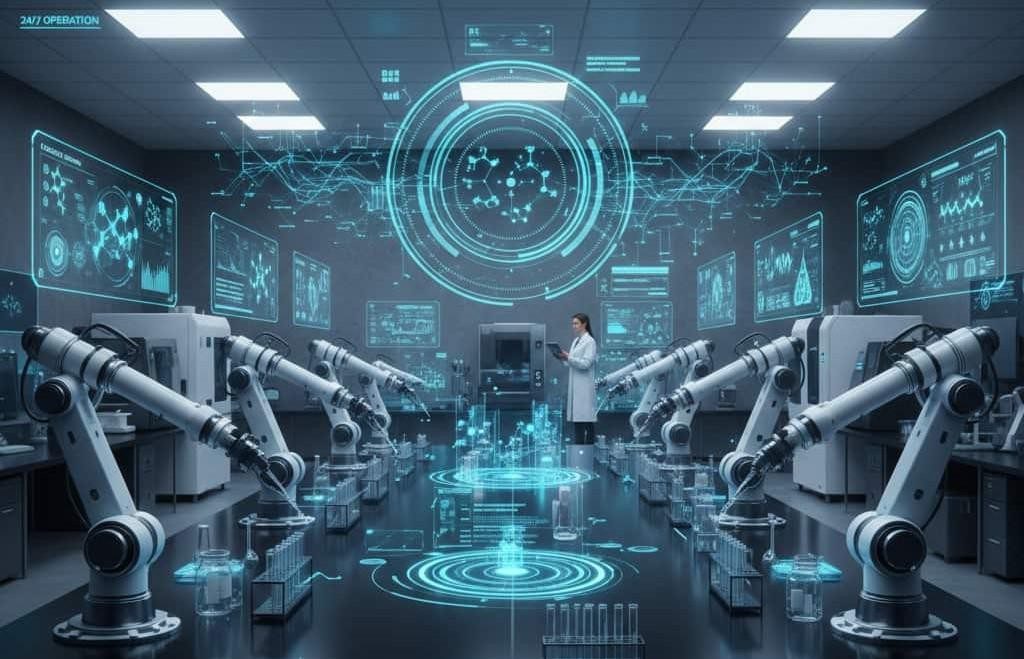
Autonomous laboratories are quickly becoming a reality! They utilize robotics, machine learning, and rapid data analysis to automate experimentation in real time.
Instead of having to conduct experiments themselves, researchers are using AI to automate all aspects of developing new compounds and materials by using robotic systems. By leveraging automated robotic systems to conduct experiments, researchers are freed from the time constraints associated with performing all of the above activities on their own.
An autonomous laboratory can conduct multiple experiments simultaneously using chemical combinations in far less time than a human researcher could conduct one experiment at a time. The AI provides direction on further refining each chemical combination based on the results of previous experiments.
In addition to conducting experiments at a faster rate, autonomous laboratories also operate with more efficiency. Human researchers can only conduct research for a limited number of hours a day. However, autonomous laboratories that utilise artificial intelligence can conduct experiments 24 hours a day for months instead of years.
You may think of it as scientists being phased out. But really the role of the scientist is changing. The goals of research, establish the limitations, and infer the larger picture of the work will still be done by the scientist. The repetitive task of experimentation will now be handled by AI in Scientific Research through its ability to repeat and improve very quickly, allowing scientists to spend more time on strategy, creativity, and critical thinking.
The benefit to reproducibility will also increase with AI in Scientific Research. In scientific experimentation performed by humans, human error has always been an issue. A slight variation in measurement or discrepancies in procedures created variability in experimental outcomes. AI in Scientific Research manages the robotic systems that execute the experiment with a uniform precision level, vastly improving the reliability and increased transparency of the results.
By 2026, laboratories will become intelligent. The laboratory will no longer just be a place for “doing experiments”; the laboratory has now become an active participant in the discovery process. At the heart of this transition to the intelligent laboratory is AI in Scientific Research, providing the opportunity for laboratories to transform into adaptive learning environments.
Human + AI Collaboration: Are Scientists Being Replaced?
Let’s cut straight to the uncomfortable question: in a world where AI in Scientific Research can produce hypotheses, model simulations and autonomously run labs, what does this leave for scientists? This is a very legitimate concern; whenever there are advancements in Automation in an industry, job security becomes a topic of discussion.
As we look to the year 2026, the answer is more nuanced. While AI represents an excellent means for processing volumes of data; identifying patterns between large datasets; and optimising variables within those datasets, science itself is not simply about recognizing patterns. Science encompasses judgement, ethics, curiosity as well as context. While AI may recommend a promising compound, it will not determine the morality behind the testing of that compound. Human beings will continue to be accountable for such decisions.
 A good analogy may be that calculators did not replace mathematicians but gave them the ability to tackle more complex equations. AI in Scientific Research will eliminate the repetitiveness and computational intensity of certain aspects of a scientist’s work; leaving the scientist to engage in higher-order thought processes: study design; interpretation of contradictory results; and developing better research questions.
Additionally, there remains the aspect of trust. Scientific findings can have a significant effect on public health, environmental policies, and the safety of technologies. They should not automatically be accepted at face value; rather researchers must validate/verify their results, ensure they understand the limitations of their AI models, and provide a means to verify that their conclusions can be replicated.
The hybrid model has been introduced in order to maximize the use of both humans and robots while still allowing humans to retain control over the process of conducting scientific research. Currently, scientists are assisting and overseeing systems that don’t function independently from them, to ensure that they comply with the test criteria of the scientific method. Therefore, AI-assisted Scientific Research Systems are designed to produce accurate and precise results based on what humans have instructed them to consider.
One could speculate whether future systems would actually replace human researchers entirely. Certainly this is true for some very narrow categories of research. However, the essence of scientific inquiry is, in large part, dependent upon the ‘creative imagination’ driven by asking questions that no existing data can illuminate. Therefore, AI, as currently utilized within the realm of Scientific Research, is assisting humans rather than supplanting humans.
The difference between augmentation and substitution represents a fundamental shift that will determine how scientific research and scientific careers will evolve over the next 10 years.
Ethical Risks and Limitations
 While AI in Scientific Research is now an incredibly valuable tool, it still has numerous problems that need resolution as it continues to advance. The faster the discovery and predictive modelling processes are developed, the more ethical and logistical risks will need to be addressed by researchers, research institutions, and policy makers. If not addressed these ethical and logistical risks could undermine all trust in science.
One of the most significant challenges around AI in Scientific Research, is the effect of bias. With the large amount of historical data that AI uses to train its models, many of these biases reflected in that historical data can be based on social, experimental and / or biased sampling methods. Therefore AI in Scientific Research could easily favour some outcomes, ignore groups that are underrepresented in medical research and misrepresent the environmental impact of new products. Without sufficient oversight, AI models will continue to perpetuate bias at scale.
Another issue is around transparency. Many AI systems are designed in such a way that they work as ‘black boxes’ and produce output without any clear explanation as to how the output was generated. You can’t just trust an AI model for drug development or
climate-related activities. Results produced through AI in Scientific Research need to have output that can be interpreted by the scientist for validation; as well as to understand and explain their decisions to regulators and/or the general public.
Finally, safety is an important issue. In laboratories that use AI tools, the cost of an incorrect or erroneous result can be substantial. AI enables researchers to accelerate the results and will also enable research facilities to generate results quickly, however, if there are not sufficient safeguards in place, there is the risk that compounds generated from AI could be toxic or environments could be adversely affected by poorly simulated scenarios. Thus, the need for human oversight.
Intellectual property and liability also must be taken into consideration by researchers and institutions.
Institutions need to reevaluate their legal and ethical frameworks due to AI in Scientific Research.
Having too much trust in AI could also prove to be a subtle danger. Researchers will likely depend too heavily on AI-generated data, causing them to lose their ability for critical thought and experimentation based on instinct alone. The goal for 2026 is to find a good rate of speed using AI in Scientific Research while still keeping the judgement of scientists at the core of the process.
The technology is a game changer, but it’s not a miracle; ethical frameworks, models that are open and accessible to all, and proper oversight are just as important as the algorithms themselves. Without ethical frameworks, models that promote transparency, and proper oversight, the technological advances made through AI in Scientific Research could become too significant a threat to humanity.
What This Means for the Future of Science

AI’s influence on scientific research in 2026 is much bigger than simply allowing for faster forms of experimentation, or smarter simulations. The development of AI tools is changing the entire process of how science is conducted, taught, and applied to the real-world with tools that allow researchers to tackle questions and problems they previously viewed as too complicated or time-consuming.
Speed is one of the biggest changes happening today. Scientific discovery cycles are becoming shorter. The speed of AI in scientific research will allow the development of hypotheses and the testing and refining of those hypotheses to occur in months instead of years. As a result, the delivery of new treatments for patients, new materials for consumers, and new technology for businesses will be much quicker than in the past.
Collaboration between researchers and their institutes worldwide is changing as well. Global networks of research institutes and researchers are now exchanging AI-generated data and
models in real time. Thanks to AI in scientific research, researchers around the world can now work together to address specific research problems by integrating information from multiple disciplines (e.g., medicine, physics, climate science), thus breaking down traditional knowledge silos, thus creating a more integrated research environment.
Education and training in science are evolving. Scientists are now not only learning how to conduct research the traditional way but also how to use AI to conduct research. There is a new skill set for scientists who will need to understand how to read model results, validate AI-generated hypotheses, and responsibly implement AI-generated insights into their experimental design.
There are also changes going on in terms of policies and funding. There is a growing trend among governments and institutions to invest in AI-enabled research because when the benefits of using AI in Scientific Research are considered, it increases the value of each dollar spent, reduces time to solve problems, and decreases duplication of efforts. The areas that are benefiting the most from this investment are health care, climate change mitigation, and advanced materials.
The culture of doing science is evolving. By implementing both human insight and AI in Scientific Research, scientists are taking on larger problems, exploring more high-risk ideas, and developing multidisciplinary projects that could not have been done without the help of AI.
Therefore, the future of the scientific endeavour is collaborative, rapid, and exploratory. AI in Scientific Research is not merely a research tool; it is a driver for a new age of scientific discovery in which human creativity and intelligence work together to stretch the limits of what we know and can achieve.
Conclusion – The New Scientific Method
 Conclusion – The New Scientific Method
As of 2026, human-led science has evolved into something much bigger. AI now plays a crucial role in scientific research, helping not only to develop experiments, but also providing predictions for what will happen and generating new hypotheses. The scientific process is changing as well. The standard method of conducting science (observe, form a hypothesis, conduct experiments and draw conclusions) still applies, but now, AI is improving and adding insight into each of these steps.
How does this affect typists? While AI provides a means by which large numbers of experiments can be done quickly and can recognise patterns, and produce other forms of information, the decision-making of scientists will continue to be the basis for how research is conducted and ultimately used in human knowledge. AI will amplify the capabilities of scientists, not replace them, and will work intuitively and computationally, working together to produce results.
Whether it be through research in medicine, climate, physical sciences or materials, the use of AI in scientific research will allow results to be produced faster, more accurately and with greater predictive capabilities than we’ve previously experienced. Examples include the development of personalised medicine to the creation of advanced climate models with predicted results that once took decades to discover now be able to produce results in a short period of time.
There will also, however, be challenges that scientists will have to overcome. Bias, transparency, safety and accountability will all be areas that require careful monitoring. However, when AI in scientific research has been applied in a responsible manner to date, it has not only increased the speed of scientific discovery, but has provided a complete change to the traditional scientific process, and opened up new lines of inquiry that were previously not possible.
The overall message is clear: the future of science will continue to evolve through the use of scientific collaboration and partnership between human beings and AI. Scientists that are willing to embrace these technologies will be the ones who will have the most success in conducting the next generation of scientific discovery.
