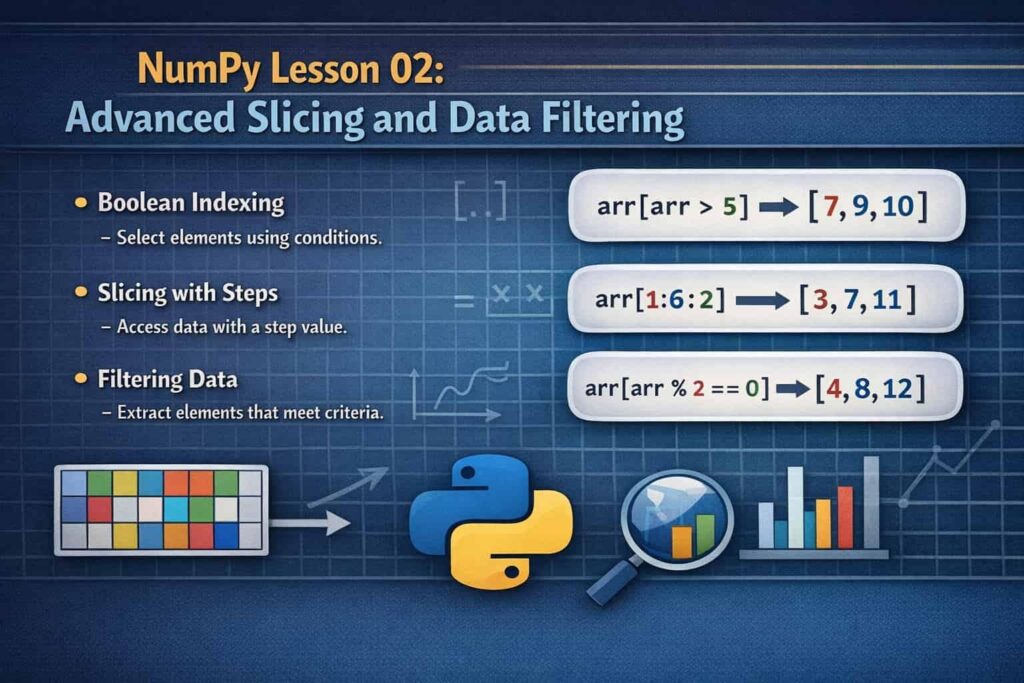
NumPy Lesson 03: Advanced Math, Broadcasting, and Vectorization (Complete Guide with Examples)

One of the most potent Python libraries for scientific and numerical computing is NumPy. Understanding advanced numpy techniques, which enable developers and data scientists to carry out intricate computations effectively, is crucial after mastering the fundamentals of arrays and basic operations.
🚀 Final Lesson Practice: To run these high-performance operations yourself, access our official Kaggle Notebook: NumPy Lesson 3. (Update to Lesson 3 link when ready).
These methods enable Python programs to perform mathematical operations far more quickly than conventional Python code, which makes them popular in data science, machine learning, and data analysis.
In this lesson, we will explore some essential concepts of advanced numpy, including:
- Vectorization
- Broadcasting
- Advanced Universal Functions
- Linear Algebra Basics
- Handling Missing Data (NaN)
Each of these features plays an important role in improving performance and simplifying code when working with numerical data.
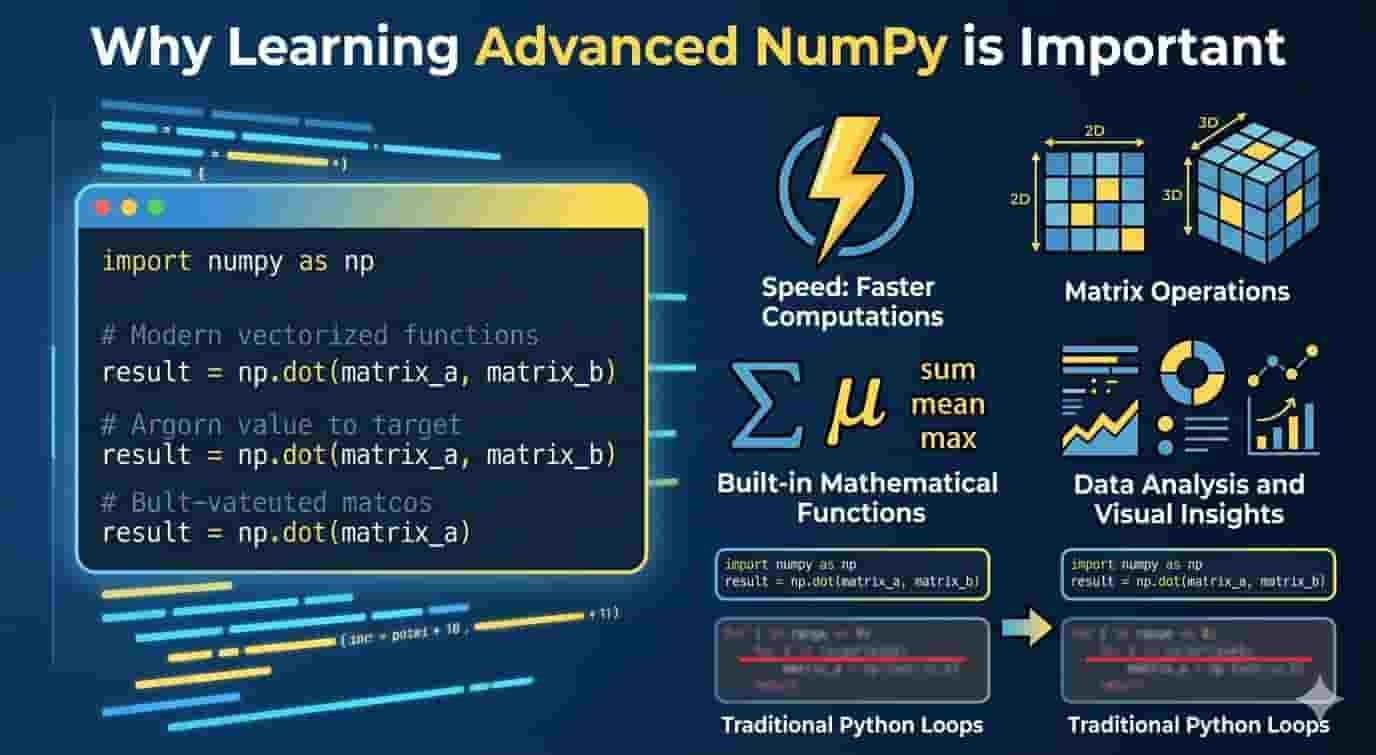
Why Learning Advanced NumPy is Important
When dealing with big datasets, performance becomes critical. When working with thousands or millions of numbers, standard Python loops may be slow.Advanced numpy is very helpful in this situation.
With the help of NumPy’s highly optimised C functions, Python can execute mathematical operations far more quickly than with standard loops.
Some key advantages of advanced numpy include:
- Faster numerical computation
- Cleaner and shorter code
- Built-in mathematical functions
- Efficient matrix operations
- Powerful tools for data analysis
Because of these features, NumPy has become a core library for data science and machine learning.
Vectorization (Speeding Up Math)
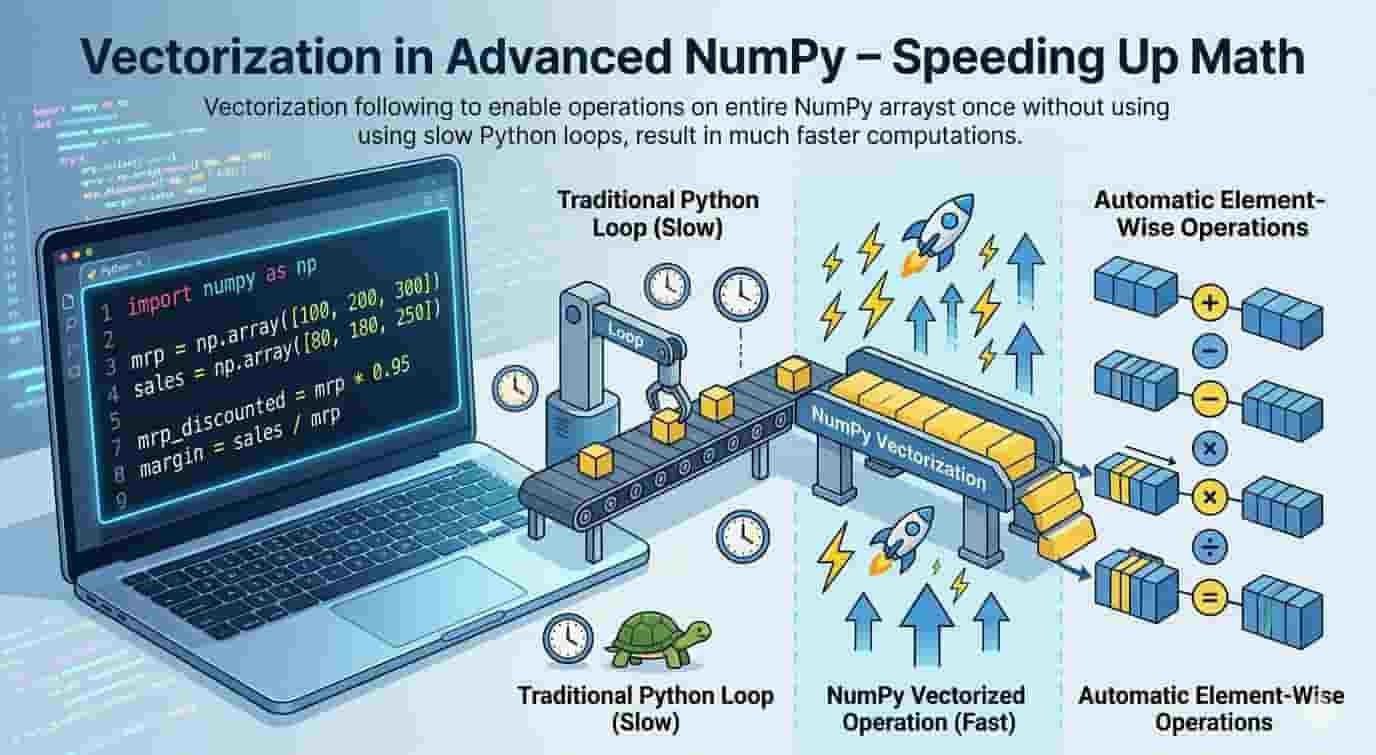
One of the most powerful concepts in advanced numpy is vectorization. In standard Python, performing operations on every element of a list usually requires writing loops. This approach works for small datasets but becomes inefficient when the data size grows.
Vectorization allows operations to be applied to an entire NumPy array at once without using loops. Internally, NumPy performs these operations in optimized C code, making them significantly faster than traditional Python loops.
Example Scenario
Suppose we want to apply a 5% discount to all MRPs and also calculate a simplified profit margin based on sales.
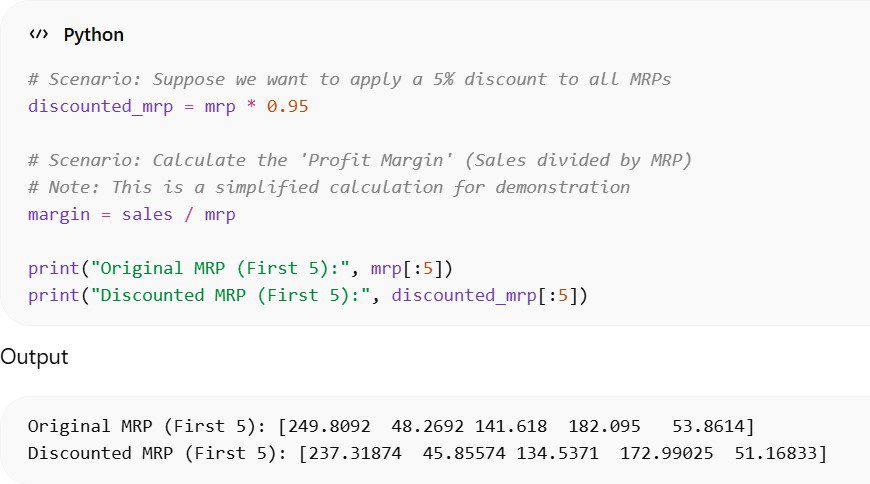
In this example, the expression mrp * 0.95 automatically multiplies every value in the array by 0.95. Similarly, the calculation margin = sales / mrp divides each sales value by the corresponding MRP value.
This process happens without writing any loops. Vectorization is one of the most important aspects of advanced numpy because it simplifies code while improving performance significantly.
Broadcasting
Another potent feature of advanced numpy is broadcasting, which enables arrays of various shapes to cooperate during arithmetic operations. Arrays must typically have the same dimensions in order to perform operations on them. Nevertheless, broadcasting allows NumPy to automatically modify array shapes so that the operation can still be carried out.
For instance, NumPy automatically applies a single number to each element in an array when it is added. The need to manually repeat values is eliminated by this behaviour.
Example: Adding Tax to Sales

In this case, the value 10 is a scalar. NumPy broadcasts this value across the entire sales
array, adding 10 to every element automatically.
Broadcasting Between Arrays
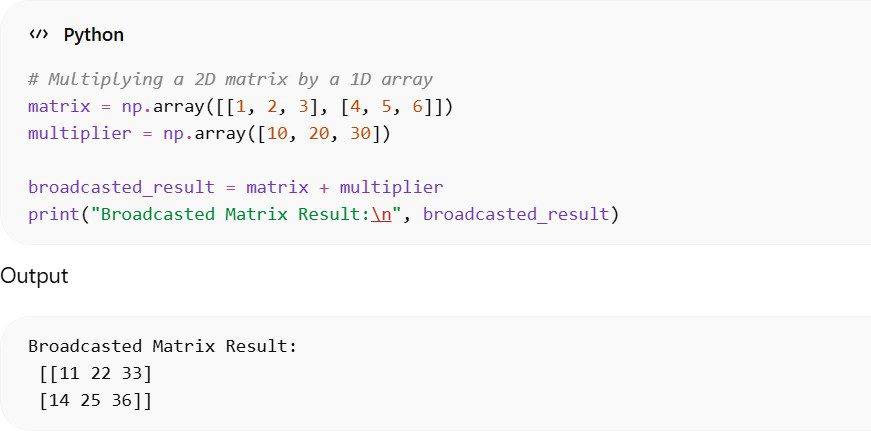
In this example, NumPy aligns the one-dimensional array with the columns of the
two-dimensional matrix and performs the addition column by column. Broadcasting is widely
used in advanced numpy because it allows complex mathematical operations to be performed with minimal code.
Advanced Universal Functions
Additionally, NumPy has a large number of built-in mathematical functions known as universal functions (ufuncs). These functions apply the computation to each individual element of an array in an element-wise manner.
Trigonometric operations, square roots, logarithms, and exponentials are a few frequently used mathematical operations. These optimised functions enable the efficient execution of complex calculations, making them crucial parts of advanced numpy.
Example: Mathematical Operations
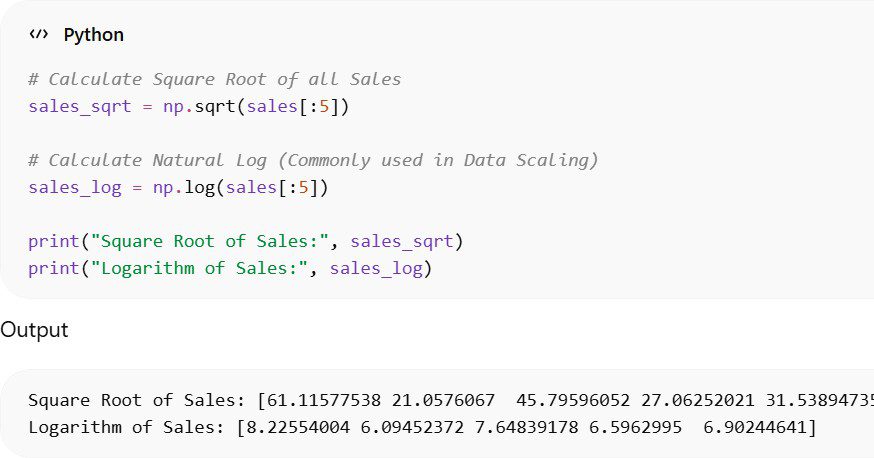
The function np.sqrt() calculates the square root of each value in the array, while np.log() calculates the natural logarithm. Logarithmic transformations are often used in machine learning and statistical analysis to normalize data and reduce skewness.
These types of operations demonstrate how advanced numpy simplifies complex mathematical transformations.
Linear Algebra Basics
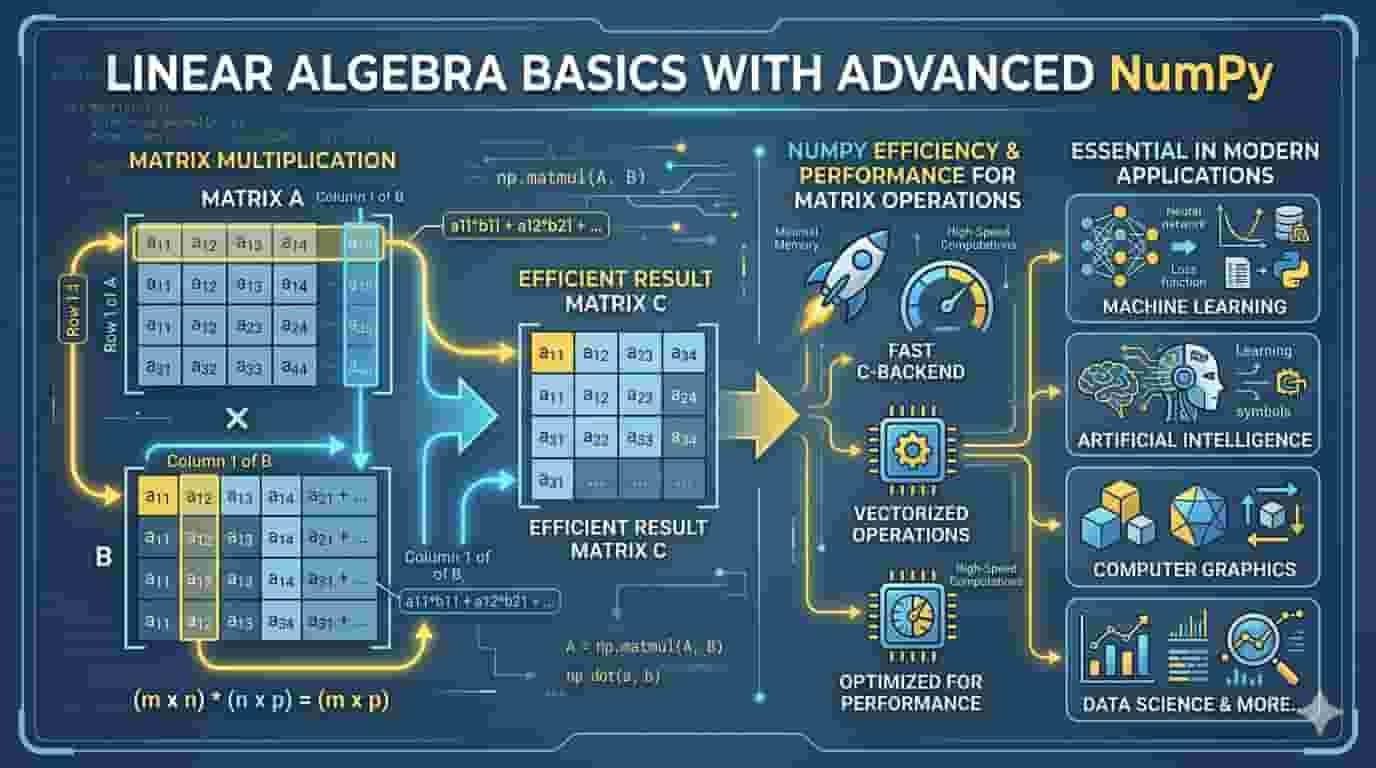
Linear algebra is a fundamental concept in many technical fields, including machine learning, artificial intelligence, and computer graphics. Many algorithms rely on matrix operations such as matrix multiplication, which can be efficiently performed using advanced NumPy.
NumPy provides built-in tools for performing linear algebra operations quickly and efficiently. One of the most common operations is the dot product, which is used in matrix multiplication.
Example
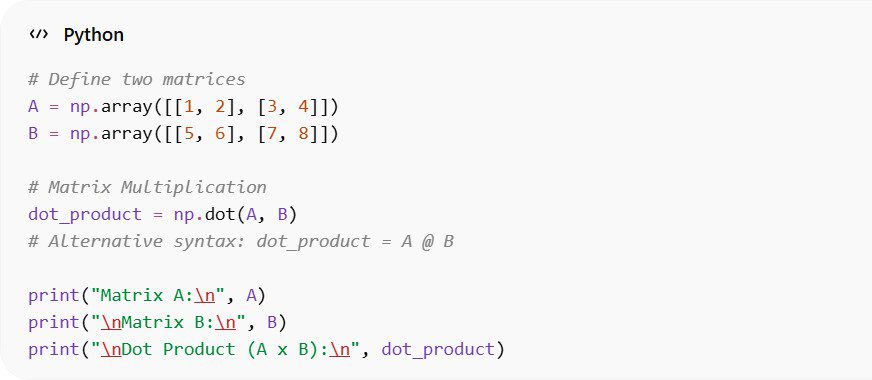
Output:
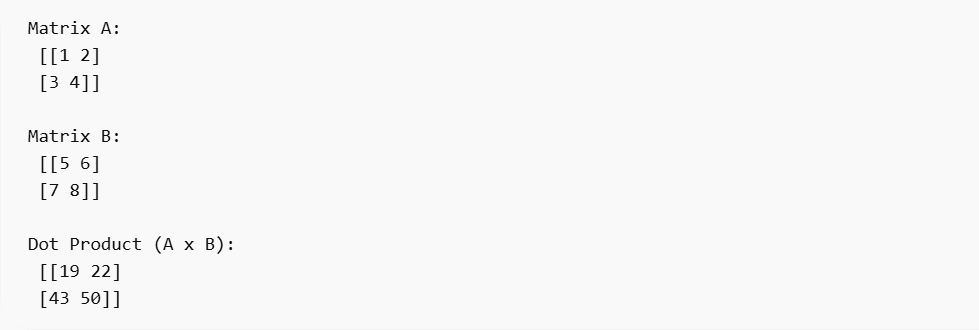
Explanation
Matrix multiplication follows specific mathematical rules.
For example:
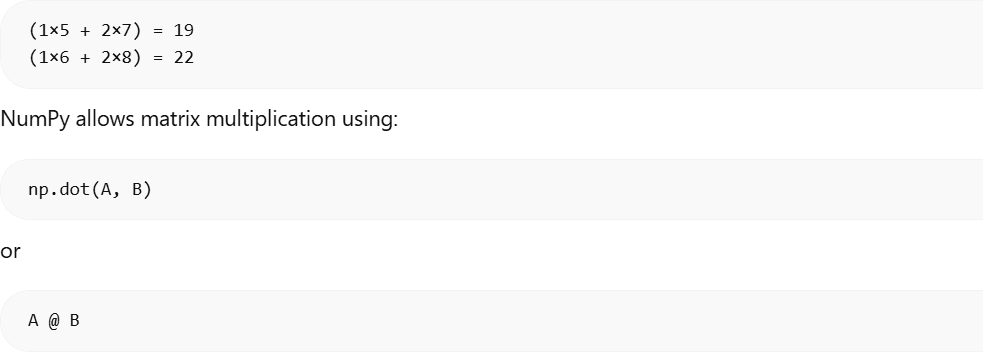
These operations are essential in machine learning algorithms such as neural networks and regression models.
Dealing with Missing Data (NaN)
Real-world datasets often contain missing values. In NumPy, missing data is represented using NaN, which stands for “Not a Number.” Standard functions such as np.mean() cannot correctly calculate results when NaN values are present.
To solve this problem, advanced numpy provides special functions that ignore missing values during calculations.
Example
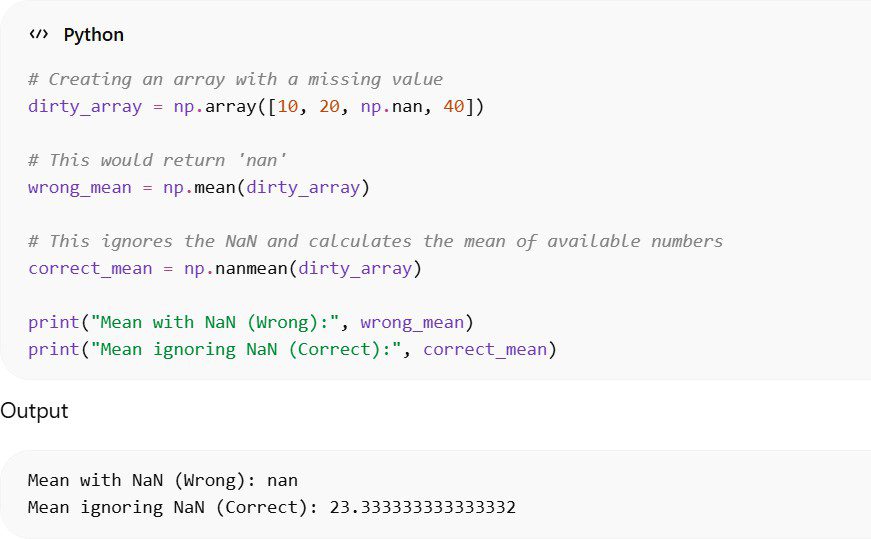
In this example, the normal mean function fails because the array contains a missing value. The function np.nanmean() ignores the missing value and calculates the mean of the remaining numbers
. Properly handling missing data is an essential part of advanced numpy when working with real-world datasets.
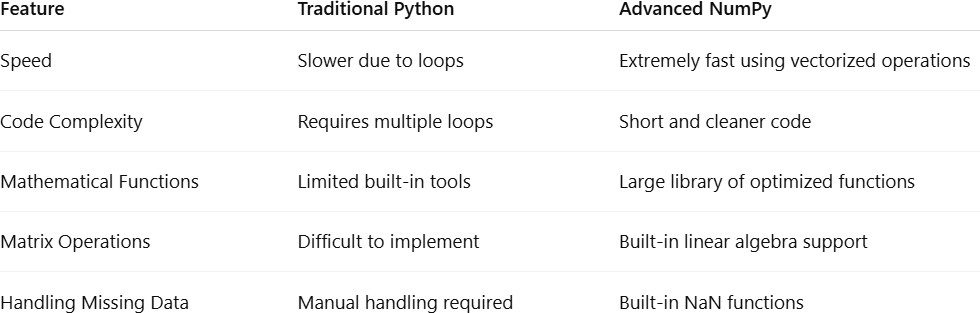
Comparison: Traditional Python vs Advanced NumPy
Key Takeaways
From this lesson, we learned several important concepts of advanced numpy:
- Vectorization speeds up calculations by removing loops.
- Broadcasting allows operations between arrays of different shapes.
- Universal functions simplify complex mathematical operations.
- Linear algebra tools support efficient matrix computations.
- NaN functions help handle missing data correctly.
These features make NumPy one of the most powerful tools for numerical computing in Python.
📚 Complete the NumPy Mastery Series
If you want to revisit any part of this journey, here are all the interactive lessons in one place:
Kaggle Notebook: NumPy Lesson 01 — Array Basics & Creation.
Kaggle Notebook: NumPy Lesson 02 — Slicing, Indexing & Data Filtering.
Kaggle Notebook: NumPy Lesson 03 — Advanced Math, Vectorization & Broadcasting.
Conclusion
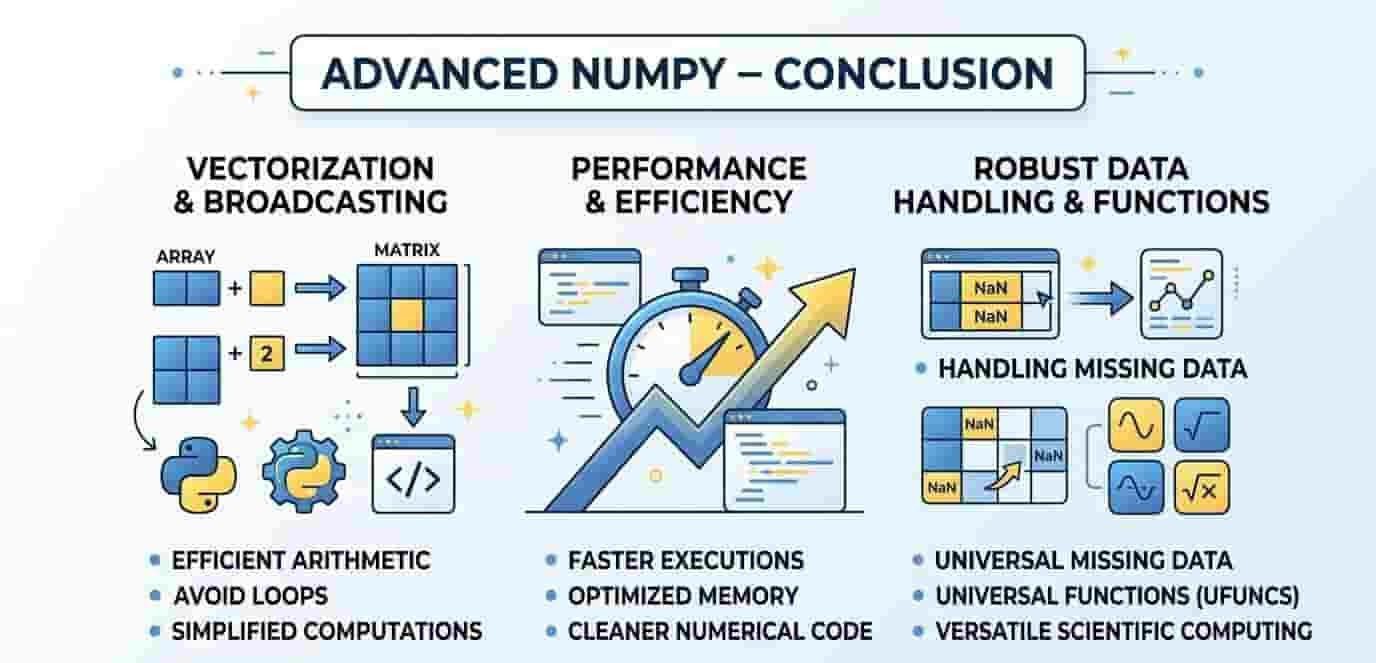
In this section of our course, we covered many techniques in advanced numpy. These include vectorization, broadcasting, universal functions, matrix operations and dealing with missing data.
These capabilities make it possible for authors of code to create faster, cleaner and more efficient numerical code. Therefore, mastering the features of advanced numpy is a critical skill for anyone who is working in data science, machine learning or scientific computing.
By continually practicing these techniques, you’ll be able to manage large datasets and easily accomplish complex mathematics.
🎓 Course Complete: Your NumPy Journey Ends Here!
Congratulations! You have successfully completed the AI Learner Tech NumPy Series. You have progressed from understanding basic array structures to mastering high-performance techniques like vectorization and broadcasting.
What’s Next? 🐼
Now that you have a solid foundation in NumPy, your next logical step is Pandas. Since Pandas is built directly on top of NumPy, you will find data manipulation and table management incredibly intuitive and easy to learn.
Ready for a Challenge? Put your skills to the test with our Big Mart Sales Prediction Project. This project is a Kaggle Bronze Medal winner and will show you how to apply NumPy and Machine Learning to a real-world retail dataset.
Professional Resources & Support
YouTube Channel: Subscribe to AI Learner Tech for video tutorials on NumPy, Data Science, and AI 🎥.
Source Code: Access the full code for this tutorial and all future projects on our GitHub Organization 📂.
Daily AI Updates: Follow us on LinkedIn for short clips, industry trends, and quick tips 🤝.
Join the Discussion: Become part of our Facebook AI Community to interact with experts 👥.
Support & Inquiries: For questions or collaborations, reach out to us at contact@ailearner.tech 📧.

Author: AI Learner Tech
AI Learner Tech is a premier research and educational hub dedicated to mastering Artificial Intelligence, Machine Learning, and Computer Vision. We bridge the gap between complex academic theories and real-world industrial applications. Join our community to access high-quality tutorials, open-source projects, and expert insights. Website: ailearner.tech